


Market Update: December 2025
Wed, 12/03/2025 - 16:15 Wealth management

Written by John M. Fidler, Chief Investment Officer
(502) 259-2543 | John.Fidler@syb.com
In our 4Q Outlook, we cautioned investors against the popular thinking that a supposed “AI bubble” was about to burst. However, we also discussed some near-term risks to the market that could create a tactical buying opportunity, which materialized (albeit in pretty benign fashion) and then de-materialized quite quickly through the end of November. The S&P 500 sold off a little under 5% from the late October highs to the week before Thanksgiving, only to rally almost all the way back to all-time highs during last week’s holiday-shortened trading week. As a result, market performance looks pretty strong on a YTD basis.
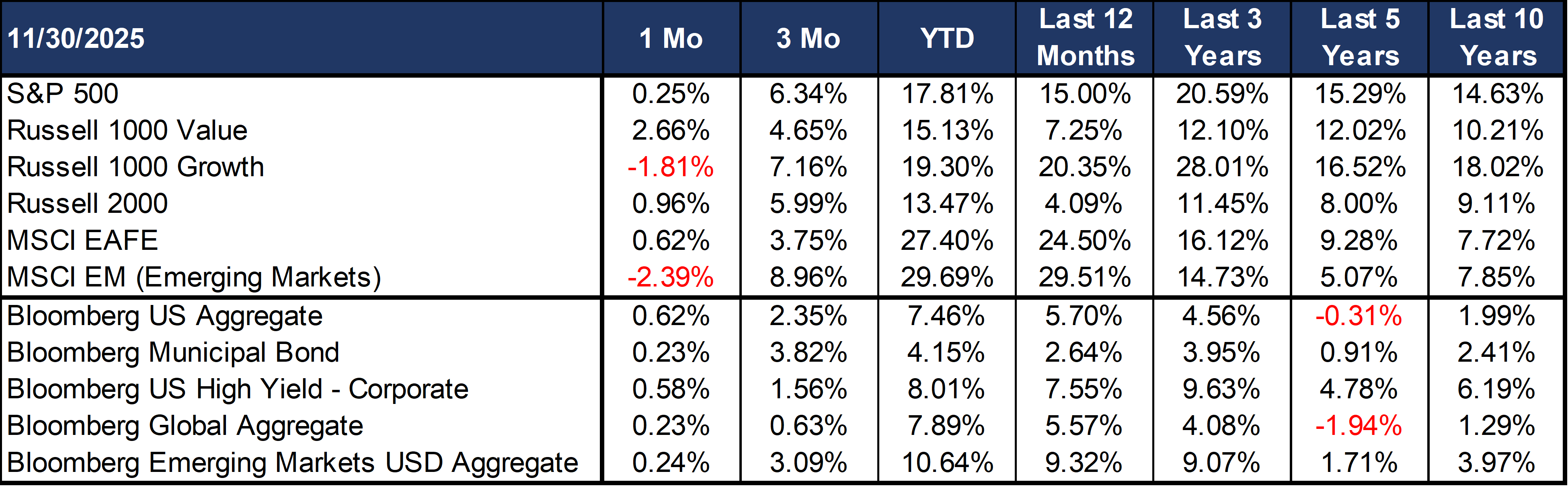
Thanksgiving week is often a low volume market, which can lead price action to be driven more by positioning and flows as opposed to fundamentals. However, while we believe the recent market moves have been more noise than signal, we have seen some dynamics we believe are more fundamentally driven and want to highlight them. The first relates to the idea of a K-shaped economy and a K-shaped market.
The idea of a K-shaped economy is relevant in several senses.
First, the consumer. High income households are continuing to spend money freely as they have benefitted from asset price appreciation (stock prices and home prices). Conversely, lower end consumers are seeing less benefit (or none at all, if they don’t own assets) and are being squeezed by a combination of slowing wage growth and sticky inflation.
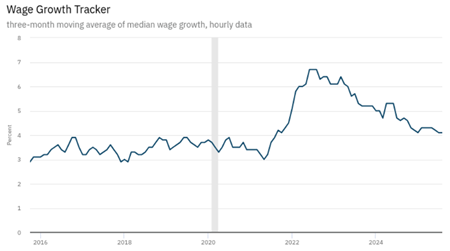
Wage growth has slowed from close to 7% following the pandemic to about 4% today:
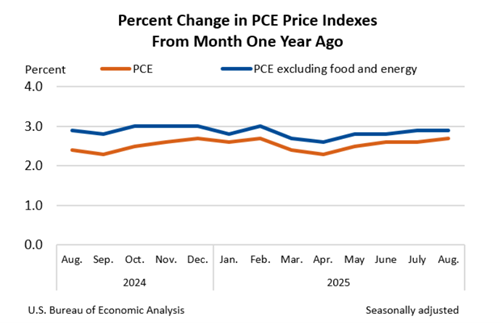
Core inflation appears to be sticky at about 3%:
Despite these factors, consumer retail spending has been unaffected, growing at the same 5%-ish clip it has done since 2023.
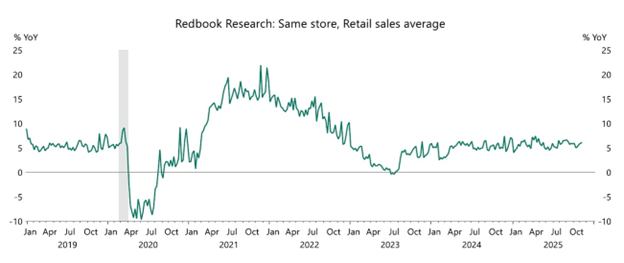
We would note that retail spending began to rebound in mid-2023, which coincides precisely with US equity markets starting to recover from the 2021-22 bear market. The massive wealth effect experienced by high end consumers since then has offset weakness at the low end: a K-shaped economy. To be clear, we would argue that the prior two charts do not show an economy that needs the Fed to cut interest rates; more on this later.
Second, we have the corporate sector, where we see evidence of K-shaped profitability and stock price performance. A narrow subset of AI-related companies has seen massive earnings growth and massive stock price appreciation since the launch of ChatGPT in November 2022. Alphabet (GOOGL) and Nvidia (NVDA) alone are responsible for over half of the S&P 500’s YTD gains in 2025. However, many sectors (e.g. Healthcare) have lagged mightily and many sub-sectors (e.g. trucking) have effectively never emerged from the recession they entered in 2022. Consumer companies have seen their price performance lag the tech-heavy S&P 500.
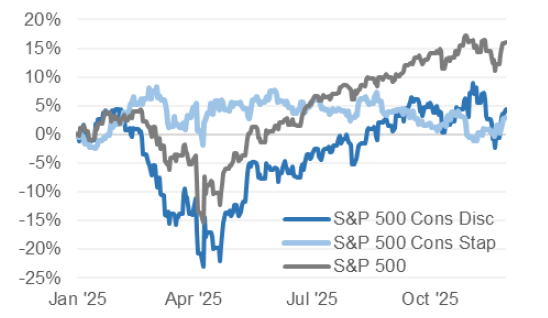
Recently, we have seen a strong bounce of some consumer companies that are highly levered to the mid/low end consumer, which have been poor performers YTD and are heavily shorted by hedge funds (think firms like Best Buy [BBY] and other physical retailers). While we tend to think the recent rally is related to positioning, as opposed to fundamentals, and will reverse, it could also be the beginning of a “flattening of the K,” so bears watching.
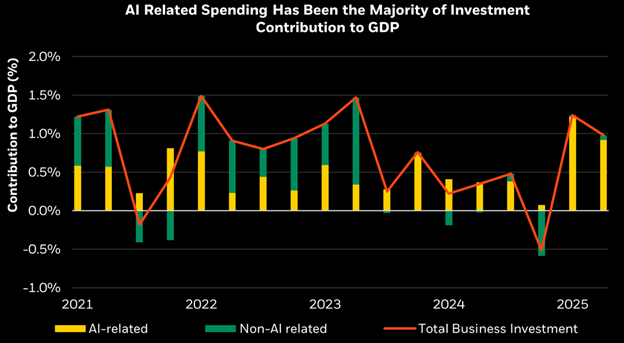
Finally, we see the K-shape in the economy broadly. AI spending has not just been driving stock prices higher, but as we mentioned in our last Outlook, AI capex has contributed a full percentage point to GDP growth this year. This represents effectively 100% of investment contribution to GDP since early last year, propping up an otherwise slowing economy.
So, we see a bifurcated K-shape among consumers, among companies, and across the economy as a whole.
Historically, markets always have winners and losers. As we cited in our mid-year Outlook, just 2% of companies were responsible for 90% of total stock market wealth creation over the past century. One of our jobs as investors is not only to identify these companies as early as we can, but to hold onto them.
However, the degree of K-shape, across such broad swaths of the economy, seems extreme at the moment. The idea of an affordability crisis that has emerged as a result of sticky inflation, be it in housing, groceries, insurance, or new/used cars, is a major political issue. New York City just elected a socialist mayor in response to these issues. President Trump is talking about sending $2,000 “tariff dividend” checks to households in response to these issues. With 2026 being an election year, these won’t be the last policy responses we see to the K-shaped economy.
What’s the fix? One potential solution appears to be ongoing and existing monetary and fiscal policies that should offset some of this dynamic next year.
For one, whether the Fed cuts interest rates this month or not (we think they will, but it’s far from certain), and whether we think the Fed should cut rates or not (we don’t), it appears the direction of travel for short-term interest rates is clearly lower. Our current expectation is that we see a 3% Fed Funds rate by the Summer. This should alleviate some pressure on consumers, though perhaps not to the degree policymakers believe it will.
Perhaps more pertinent, just as we have yet to see the full impact of tariffs on the economy (a potential downside risk to growth), we have yet to see the full impact of important provisions of the One Big Beautiful Bill (BBB) passed this Summer (a potential upside risk to growth). The non-partisan Congressional Budget Office (CBO) estimates that the BBB will boost GDP growth by almost 1% in 2026. Businesses can immediately deduct capital expenses, such as investments in equipment and R&D (such as datacenters and semiconductors). Household tax cuts (and therefore tax rebates hitting bank accounts in 1H26) will account for about half of this boost, according to Evercore ISI. On top of this, we have the potential for “tariff dividend” checks. While another stimulus program may seem far-fetched now, we would expect (1) Democrats have limited power to stop such a move as we approach another government shutdown at the end of January, and (2) both parties will resort to populist measures aimed at shoring up support headed into the 2026 mid-term elections.
Whether this policy mix will “flatten the K” of both markets and the economy, or rather create another inflation problem, and the ensuing implications for markets, will be a key dynamic in the coming year.
We wish everyone the best for a happy and healthy holiday season. Please reach out to us any time with questions.
We provide the information in this newsletter for general guidance only. It does not constitute the provision of legal advice, tax advice, accounting services, investment advice, or professional consulting of any kind. The information provided herein should not be used as a substitute for consultation with professional tax, accounting, investment, legal, or other competent advisers. Before making any decision or taking any action, you should consult a professional adviser who has been provided with all pertinent facts relevant to your particular situation. The information is provided “as is,” with no assurance or guarantee of completeness, accuracy, or timeliness of the information, and without warranty of any kind, expressed or implied, including but not limited to warranties of performance, merchantability, and fitness for a particular purpose.
Investment and Insurance Products are: Not Bank Guaranteed | Not a Deposit | May Lose Value | Not FDIC Insured | Not Insured By Any Federal Government Agency