


Market Update: May 2026
Wed, 12/03/2025 - 16:15 Wealth management

This material includes forward-looking statements. See end of this article for important disclosures. Past performance does not guarantee future results.
Written by John M. Fidler, Chief Investment Officer
(502) 259-2543 | John.Fidler@syb.com
Too Far, Too Fast?
Since quarter-end, a ceasefire/stalemate in the Middle East, combined with a very strong corporate earnings season in the US, drove a rapid recovery in US stocks. From market low on March 30, the S&P 500 has rallied almost 14% (as of this writing), pretty much in a straight line (the S&P 500 rose 12 out of 13 days in early/mid-April), in one of the more violent market reversals we can recall. Equity markets reflect very different valuations and sentiment than they did when we last wrote at the end of March, when stocks and bonds were both negative for the year.
Earnings growth remains robust and it has been a great earnings season. S&P 500 earnings have grown around 20% since early 2025. Analyst expectations for the next 12 months’ earnings growth have gone from around 14% to nearly 18% since first quarter earnings season began. Strong earnings growth and positive earnings estimate revisions are a positive driver for stocks, though the latter certainly sets the bar higher for future expectations.
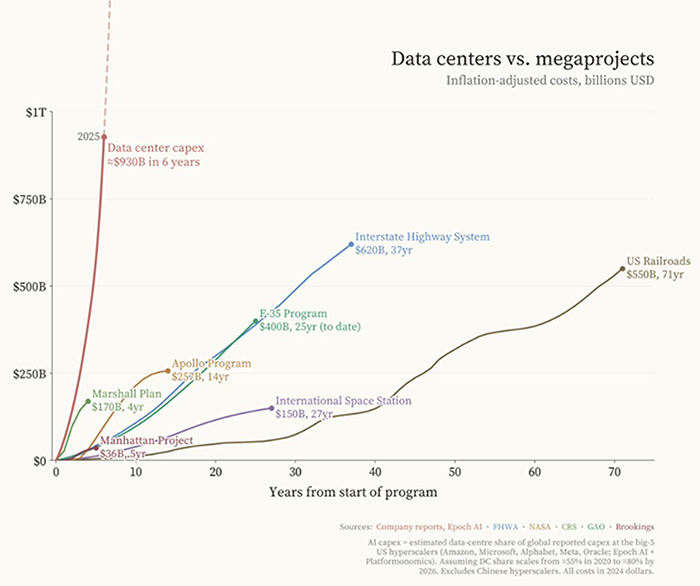
Almost every major tech firm continues to spend heavily on the AI platform shift, with the hyperscalers (Alphabet, Amazon, Meta, Microsoft) expected to now exceed $700B in capital expenditures in 2026, up almost 80% from 2025.
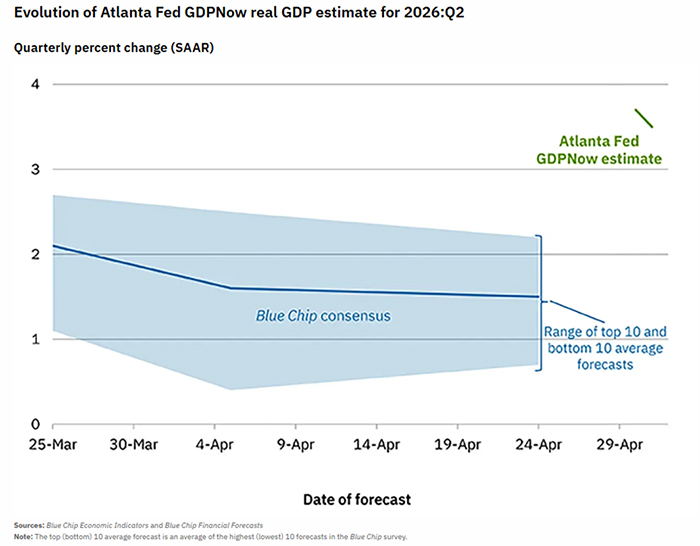
The fundamentals of the US economy remain solid, with 2Q26 GDP growth expected to be over 3%.
The economic backdrop reflects the strength we discussed in our 2026 Outlook. This has not changed, despite the Iran conflict. Developed stock markets (US and International) are up around 6% YTD through April, but due to earnings growth, forward valuations haven’t moved much. Neither have bond yields.
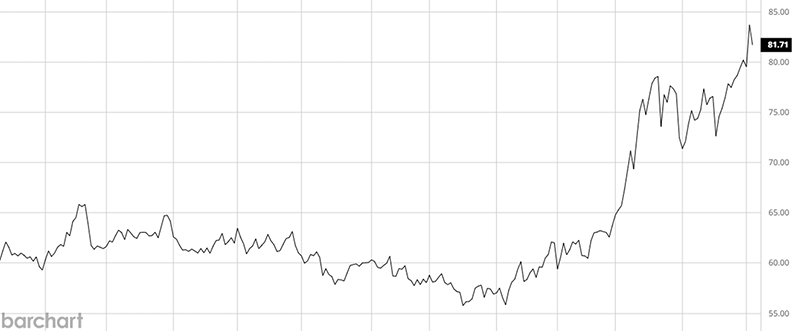
What has changed are commodity prices and the expected path of monetary and fiscal policy. While US equities have more than retraced their entire 1Q26 sell-off, oil prices have retreated very little, if at all, from the war-time highs seen in late March. For instance, forward oil prices, as measured by the December 2026 WTI Crude Oil futures contract (WTI is the benchmark for US oil prices) made a high of around $79 on March 23. They then retreated to just above $70 in mid-April. But, since then, that oil contract has more than fully recovered and sits around $82 today.
December 2026 Crude Oil price (1 year chart)
In addition to oil, the stalemate in the Strait of Hormuz impacts many other global commodity markets and supply chains, from fertilizer to chemicals used in the production of steel and semiconductors. Countries across Asia and Europe are rationing gasoline and warning of jet fuel shortages. These aren’t positive drivers for the global economy or global markets, and substantial risks remain, though stock markets seem to be looking past them.
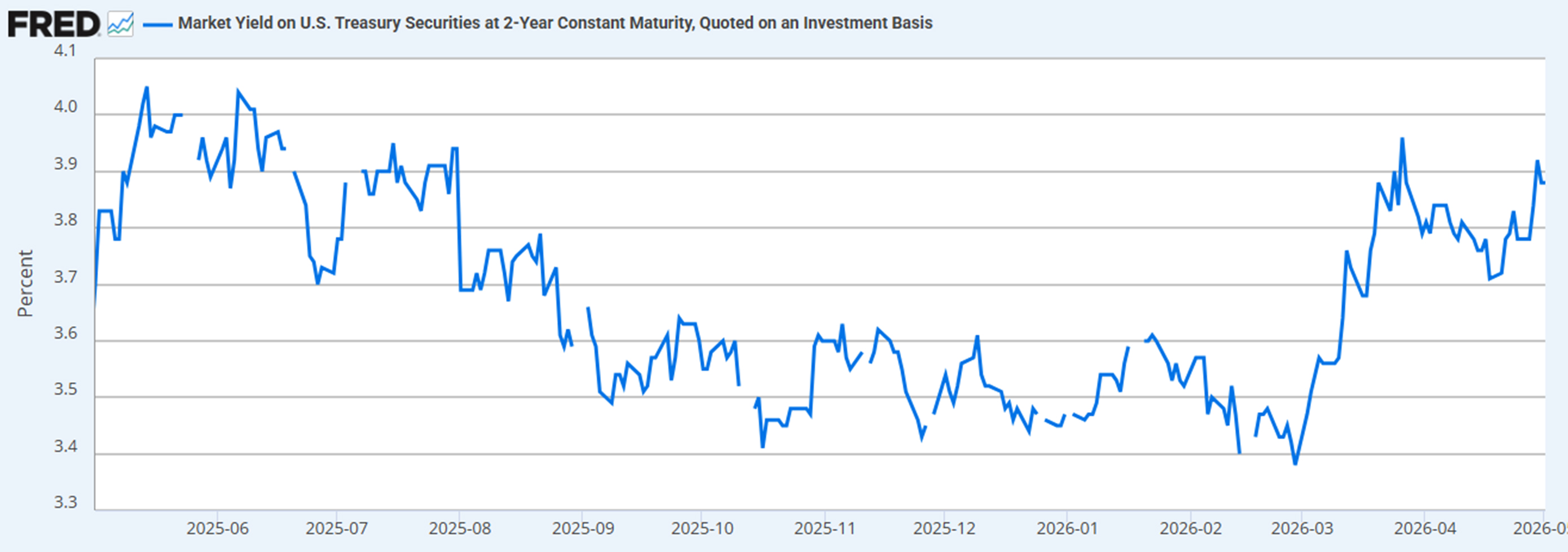
Entering the year, fixed income markets were pricing that the post-Powell Fed would cut interest rates roughly twice in 2026. Stubbornly high inflation (exacerbated by the conflict in Iran) has complicated this glide path. Moreover, Chairman Powell announced that he will be the first Fed Chair since the Truman Administration to stay on the FOMC after his departure as Chair. Powell appears substantially more hawkish than Kevin Warsh, who will likely take over as Fed Chair next month, and Powell’s continued presence seems likely to complicate decision-making dynamics within the Committee. So, expected monetary easing has shifted to an expected extended pause, leading to an uptick in 2-year interest rates.
We wrote in our 2026 Outlook that further fiscal stimulus was possible ahead of the mid-term elections. Again, the Iran conflict complicates things. Given deficit pressures and political dynamics, a reconciliation bill that expands beyond Iran and Homeland Security and provides incremental stimulus looks unlikely. With the Supreme Court ruling against the Trump emergency tariffs, a “tariff dividend” for taxpayers now looks to be a dead issue. The tax refunds and accelerated depreciation related to the One Big Beautiful Bill (OBBB) are spurring economic growth as expected, and we see this showing up in numbers. But further stimulus before the Fall elections now looks to be an increasingly low probability event.
So, the economy is good, earnings growth is great, credit markets are in decent shape, and the labor market isn’t falling off a cliff. But much of this good news is now priced into markets. Oil prices remain high, rate cuts look unlikely, and fiscal tailwinds will likely flip to headwinds in 2H26. So, all in all, we see a market that has perhaps come “too far, too fast” since March 30 (barring a reversal of one or more of the fundamental dynamics we just mentioned, which would lead to more upside for stocks). This doesn’t mean we are taking portfolios to cash, given all the positive drivers we discussed at the outset. But it does mean we aren’t chasing stocks at these levels and are thinking tactically about portfolio positioning and cash needs. For clients that have upcoming cash needs between now and year-end, the current moment presents an attractive spot to do that.
Tactically, we continue to target unloved areas of the market (e.g. selected software and financial services companies) for incremental investment dollars. With only modest shifts in interest rates and the yield curve on a YTD basis, within bond portfolios we continue to barbell shorter-term corporate and Treasury bonds with longer-term municipal bonds to maximize yields without overextending duration. Good opportunities still exist within hedged or alternative fixed income strategies as a high yield replacement. Commodities and liquid alternatives have performed well this year, and we are, generally speaking, maintaining those exposures as they provide the best protection in the event of a deterioration of the situation in Iran that hits stock and bond markets. If that comes to pass, our portfolios should outperform traditional stock/bond allocations. If it doesn’t, and stocks continue to run higher, they may not outperform. We are comfortable with that risk/reward proposition, given again-elevated equity valuations and significant geopolitical uncertainties.
We hope you enjoyed a great Kentucky Derby weekend. Please reach out any time with questions.
We provide the information in this newsletter for general guidance only. It does not constitute the provision of legal advice, tax advice, accounting services, investment advice, or professional consulting of any kind. The information provided herein should not be used as a substitute for consultation with professional tax, accounting, investment, legal, or other competent advisers. Before making any decision or taking any action, you should consult a professional adviser who has been provided with all pertinent facts relevant to your particular situation. The information is provided “as is,” with no assurance or guarantee of completeness, accuracy, or timeliness of the information, and without warranty of any kind, expressed or implied, including but not limited to warranties of performance, merchantability, and fitness for a particular purpose.
Certain statements contained in this material constitute forward-looking statements based on current expectations, estimates, and assumptions. These statements are subject to significant risks and uncertainties that may cause actual results to differ materially from those expressed or implied. Forward-looking statements are not guarantees of future performance and should not be relied upon as such. Past performance does not guarantee future results.
Investment and Insurance Products are: Not Bank Guaranteed | Not a Deposit | May Lose Value | Not FDIC Insured | Not Insured By Any Federal Government Agency