


Market Outlook Q1 2025: Curb Your Enthusiasm
Mon, 01/27/2025 - 08:20 Wealth management

John M. Fidler | Chief Investment Officer
(502) 259-2543 | John.Fidler@syb.com
Q4 Review
Investors had much to cheer as 2024 came to a close. The S&P 500 gained over 20% in back-to-back years, the first time this has happened since the heady days of the tech bubble in 1999. Under the hood, however, not all investing styles fared equally: value stocks markedly lagged growth stocks (+15% vs +33%, respectively), as they have consistently over the past two decades. Pure “value” investing (i.e. buying low-growth companies with optically low valuations) continues to be a losing strategy except in years when equity markets overall perform poorly. Similarly, diversification across countries and company sizes has added little value for investors since the Great Financial Crisis (GFC). Developed international stocks (+4%), emerging market stocks (+13%), and small caps (+18%) all lagged the S&P 500 (+25%). Breadth was excellent in the 3rd quarter, but prior leadership of US growth stocks reestablished dominance to close the year.
Interest rates oscillated in 2024, remaining “higher for longer,” and ultimately moving slightly higher. This fueled a mundane year with the Bloomberg US Aggregate bond index up just +1.3%; however, diversified fixed income in portfolios likely fared better with credit spreads tightening amid a resilient economy. Bond returns have been uninspiring for a decade, but with higher rates to lock-in, the forward outlook for investors is relatively more constructive, in our view.
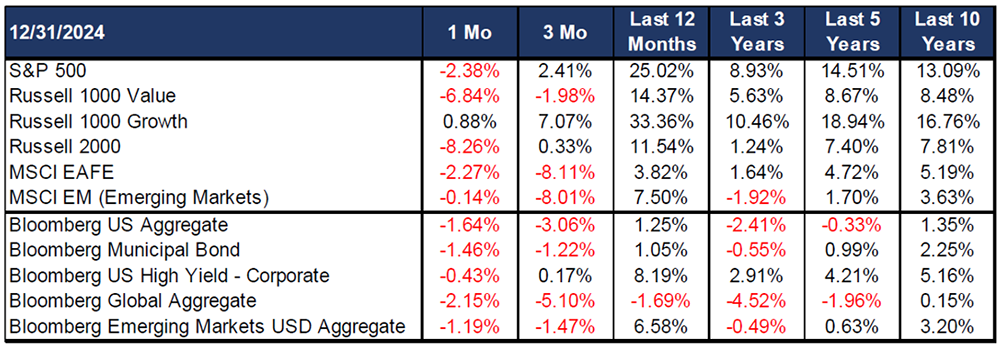
Since the 2022 market lows, just 10 stocks (you know which ones) are responsible for 60% of index-level gains. To put it bluntly: American exceptionalism is alive and well in both the global economy (where the US is an island of growth) and global markets (where the US makes up 70% of the MSCI World global stock index, despite the US representing about a quarter of global GDP).

So, we should abandon stocks outside of the Magnificent 7 (Mag7) and embrace the New World Order, right? After all, they have been the only game in town for more than two years. Not so fast. If we look at our best 2024 performers, plenty are outside the Mag7:
- Engineering and construction firm Emcor (EME) gained over 111%
- Broadcom (AVGO, +110%) is levered to the artificial intelligence (AI) megatrend, but was not on the radar of many investors until it became the latest $1 trillion market cap company late in 2024
- Oracle (ORCL), long perceived as a sleepy database company as opposed to a 4th “hyperscaler,” rose 60%
- Blue chip megabank JP Morgan Chase (JPM) gained 44%
- Discount retailer Costco (COST) gained nearly 40%
- Even beleaguered Disney (DIS) returned about 25%, in line with the S&P 500
Conversely, Microsoft (MSFT) is the third largest company by market cap in the world, but gained just 13% last year, about half the S&P 500 gain.
So, we should be contrarians and avoid the over-hyped Mag7 stocks, right? Again, the reality is more nuanced than the headlines. Excluding Tesla, the Mag7 are priced at an average forward price-to-earnings ratio (NTM P/E) of 27x versus 22x for the S&P 500 index; optically expensive, but less so when considering their return on invested capital (ROIC) of 43% (>5x the index) and expected 2025 revenue growth of ~20% (>3x the index). In this context, we believe a valuation premium is justified based on the quality of these businesses. Even within the Mag7, there is dispersion in terms of valuation, growth and quality. If (when) the market corrects, these stocks will each likely go down given high index weighting and thus mechanically high correlation, but this group nevertheless holds compelling investment opportunities.
Ultimately, as long-term investors and fiduciary managers, we will continue to tilt portfolios towards the better risk/reward set-ups and larger margins of safety, both within this Mag7 group and across the broader market.
Drivers of the Economy
Throughout 2024, we and others used the word “resilient” to describe the US economy. Coming into 2024, many expected a recession, yet instead we saw stubbornly strong growth. As we enter 2025, the economy is not just resilient, it seems to be re-accelerating. This has been evident in a number of US economic releases in December and early January, namely employment, ISM prices paid, and retail sales. Fed cuts in 2H24 increasingly look like a policy mistake.
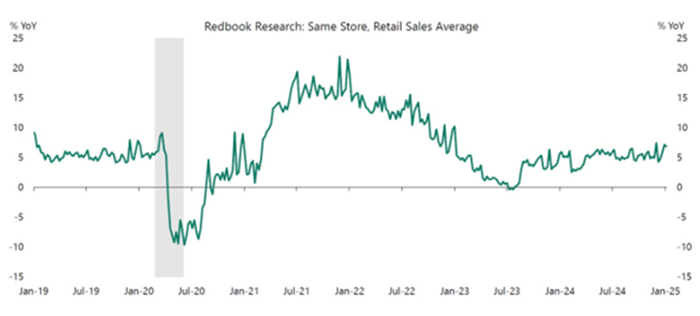
We asked a rhetorical question in our last quarterly outlook: “What would a soft landing look like?” The obvious answer is: What we are seeing right now is what it would look like. All critical sectors of the US economy are in expansion mode, aside from housing. And the slowdown in home turnover has more to do with high prices and high rates themselves in response to a strong economy than a tapped-out consumer.

We look at four key pillars of the economy to give us a roadmap for what forward growth (and inflation) are likely to look like:
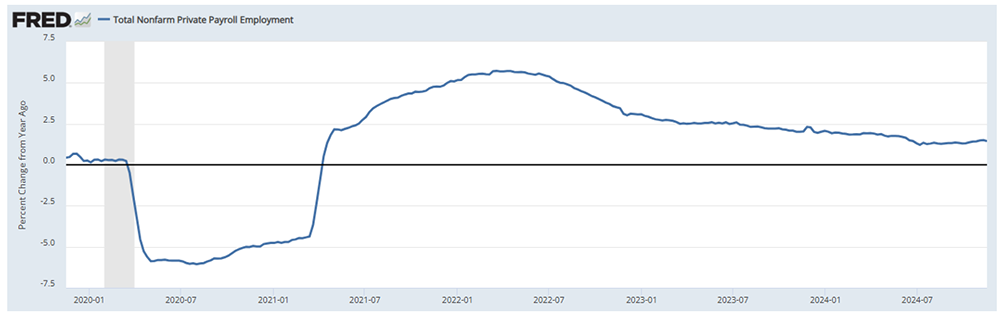
- The Labor Market. The job market is admittedly a lagging indicator, meaning it is often the last piece of the economic puzzle to roll over when we enter a recession. But whether we look at government payrolls data, Federal tax receipts, job openings, ISM employment survey data, small business hiring plan surveys, Challenger job cuts, jobless claims or ADP private sector employment (below) the picture is consistent with the labor market being strong and stable, albeit not at the extreme secularly tight levels seen in 2022.
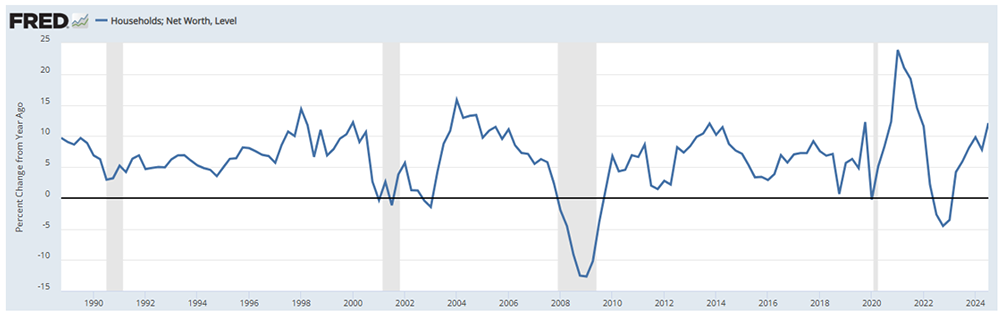
- Household wealth. Stock prices (and therefore household wealth) tend to fall before major economic slowdowns. This is admittedly a bit of a circular, or at least coincident, indicator for investors; however, there is no downward trend in household wealth consistent with an imminent economic downturn, such as we saw in prior recessions (shaded in gray below).
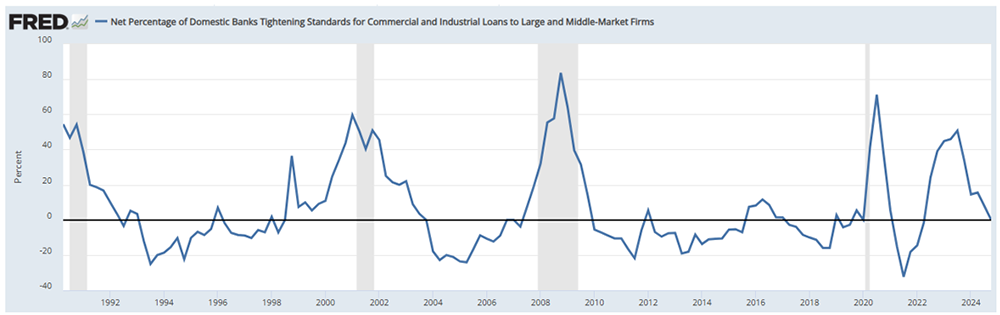
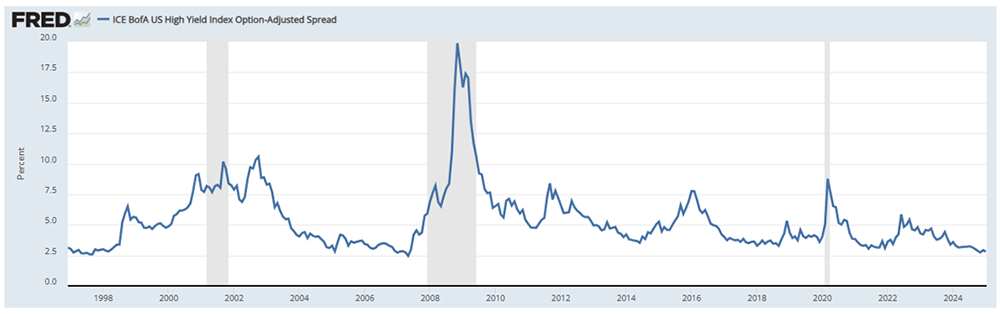
- Credit Markets. Despite Fed commentary that financial conditions are restrictive, both bank lending and credit markets appear fairly accommodative. About as many banks are loosening their lending standards as are tightening them, and corporate credit markets are sanguine on the prospects for the economy, demanding the lowest risk premium over Treasuries since prior to the GFC (i.e. tight credit spreads, as discussed prior). Again, we would expect both these indicators to deteriorate prior to a recession, not the opposite.
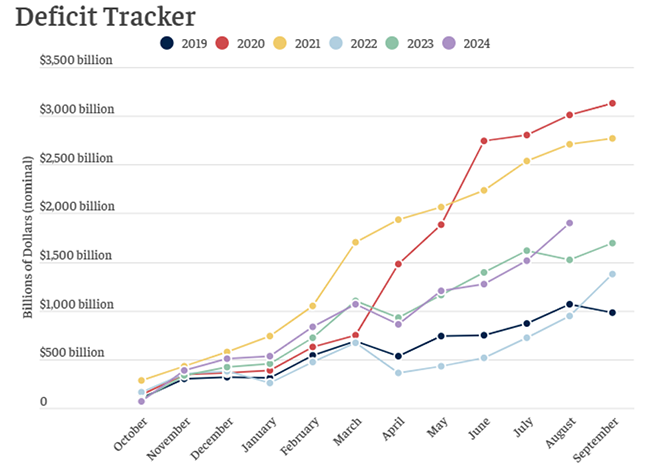
- Government Spending. While the Federal budget deficit contracted over the past three years relative to the nosebleed levels during COVID, it remained around 7% of GDP last year. The Congressional Budget Office expects deficit spending to run between 6% and 7% of GDP this year, which is unprecedented in a peacetime economic expansion. Excitement around Elon Musk’s DOGE initiative notwithstanding, there is little that can be done to structurally shrink the deficit during Trump’s second term without addressing the so-called third rail of American politics: entitlement spending.
Trump 2.0
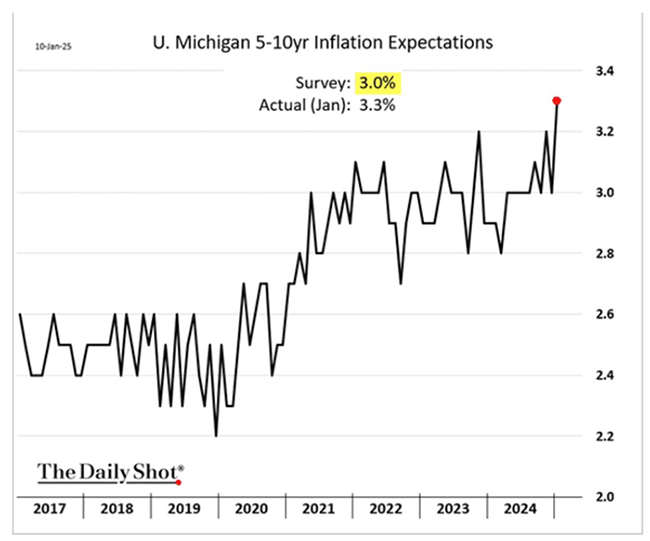
If there is one major economic takeaway from this outlook, it’s that we remain in a “higher for longer” environment. Growth is stronger than expected and looks set to stay that way in 2025. In part as a result, as we’ve written about for over a year, inflation has remained stubbornly high. The widespread expectation is for Trump tariff and immigration policies to add fuel to this fire, which in turn have pushed inflation expectations higher.
As a result, bond investors find themselves in what Bank of America’s Michael Hartnett has termed “the 3rd Great Bond Bear Market of the past 240 years.” The first occurred in 1899-1920, when long-term yields rose from around 3% to 6%. The second is more familiar to investors alive today: when rates went from around 2% to north of 15% from the end of WWII to 1981. Since 2020, 10-year Treasury yields have risen from close to zero to nearly 5% (as of this writing).
So, inflation (or at least inflation expectations, which often matter more for markets) seems to be picking up. Investors fear a repeat of 2022, where commodities and natural resource companies rose, but everything else went down sharply. We saw those fears borne out in the price action of markets in early January.

However, as a wise man (Mark Twain) once said “history doesn’t repeat itself, but it often rhymes.” A full-fledged annus horribilis such as we saw in 2022 seems quite unlikely. In 2022, financial markets faced a Fed intent on enacting the fastest rate hiking cycle in history. In 2025, we are more likely to see a modest course correction by the Fed (from easing to pausing) or, in a worst-case scenario, modest rate hikes later in the year, if inflation proves truly problematic. That would be bad for financial markets and would call into question the Fed’s credibility. But, as of this writing, with bond markets pricing at most one cut in 2H25 and bond yields spiking towards 5%, it feels as though this possibility is close to being fully, if not overly, discounted by markets.
In the longer run, deregulation during the Trump Administration would support disinflationary growth. Moreover, the inflationary impact of tariffs may be overstated, because a strong dollar cancels out a lot of the impact. The US dollar has traded 10% higher since September and is 3% away from the 2022 highs. As this becomes internalized by market participants, the inflation trade we have seen so far in 2025 (oil up, bonds down, stocks volatile) could well reverse. There is also the potential for insurance price increases, in the wake of this Summer’s hurricanes and the horrific Los Angeles wildfires, to drive home affordability to a level such that that we see home prices, and therefore core inflation, eventually fall.
However, these disinflationary/deflationary impulses are likely more of a mid-year event. In the near-term, the inflation scare seems likely to persist, as oil remains strong and this is a big driver for headline inflation. As a result, we see potential for the rest of 1Q to be a bit of a 2022 redux, giving way to an attractive buying opportunity for risk assets in the early Spring.
Trump 2.0 seems to have a more seasoned economic team than did Trump 1.0 (especially Treasury Secretary Scott Bessent), but that is not to say that Trump 2.0 is without risks. We expect to see tariff-related “tape bombs” (unexpected announcements that tank a stock or a set of stocks), similar to 2017-19. And, just as inflation fears are perhaps being overly discounted, generic pro-cyclical/pro-business optimism on Trump 2.0 may be as well. For example, a recent survey showed 85% of CEOs as optimistic on the economy, and this with earnings estimates falling. While animal spirits and optimism are high presently, a turning of the tide in business sentiment could underwrite a larger correction in 1H25.
“Price Is What You Pay, Value Is What You Get”
Further to this point: Valuations matter. Paying 22x forward earnings can work for investors if earnings are growing at 10-15%. But not so much if growth is sub-10%. Currently, 4Q24 earnings estimates imply around 12% YoY growth, but this is down from an expectation of closer to 15% in September.
If we look at the S&P 500 on a simple earnings basis (earnings divided by price, inverse of the P/E ratio), it implies an expected return of 4-5%. If we add in dividend yields and the implicit yields from corporate stock buybacks, it’s reasonable to expect a total return of, say, 4-7% for 2025.
Historical return studies like the one below are, at first blush, even more disconcerting: forward P/E ratios at current levels are consistent with close low-single-digit annualized stock returns over the subsequent 10 years, though they are largely meaningless for subsequent 1-year returns. Market luminaries like Howard Marks (and others) have been using this chart to project their skepticism about the stock market. In our view, this chart is a canard.
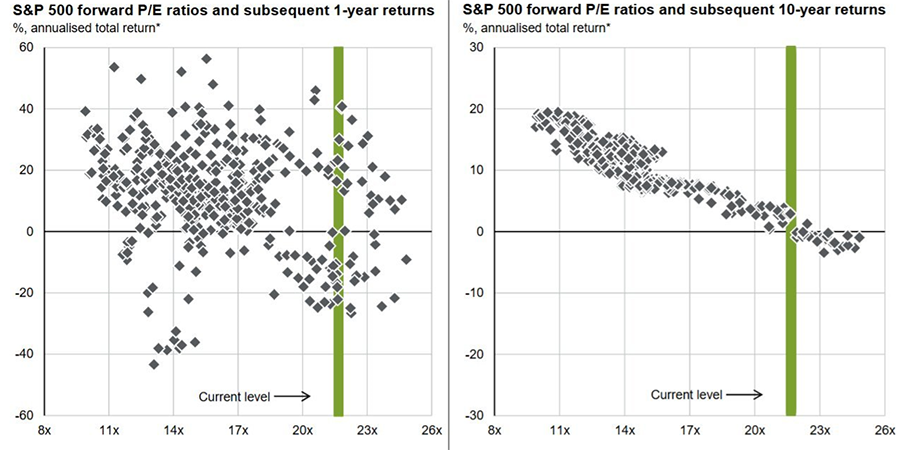
The problem with the analysis in the right-hand chart is that it samples 10-year forward returns every month. As a result, the observations are overlapping. This means that the two major bear markets of the 21st century (starting in 2000 and 2007, respectively) are overrepresented. All the chart on the right tells us is that the 2000-03 and 2007-09 bear market started from expensive forward P/E levels. If we look at the past 30 years on a non-overlapping basis, the picture is less clear.
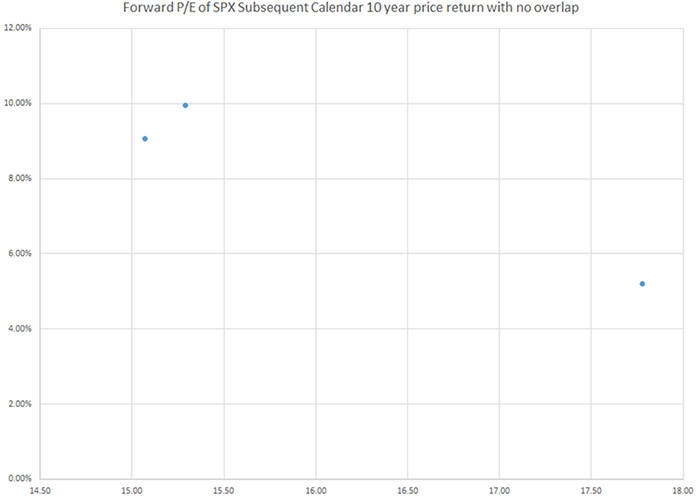
So, perhaps our expected returns for the next 10 years should look a bit like the data point on the right: below long-term historical averages, but not disastrous. Nothing to get excited about, but better than the doomsayers would have you believe. Not great, but it could be worse.

In short, both bulls and bears need to curb their enthusiasm. Markets don’t crash when the economy is firing on all cylinders and, as of now, the odds of a 2025 recession look very low. The market isn’t cheap, but this tells us precious little about what 10-year returns will be, let alone those for 2025. At the same time, markets don’t make 15%/year forever. Investors have gotten spoiled. Future returns won’t be as high as past returns. And markets don’t levitate when fiscal and monetary policy are tightening. New Treasury Secretary Scott Bessent is making a lot of noise about reducing the deficit. If it proves to be more than noise, it removes THE major driver of liquidity and investor returns in 2024. With inflation and growth re-accelerating, the chances of the Fed not just pausing, but actually HIKING rates in 2025 are rising.
Add all this up, and we expect a modest up year with a lot of volatility. We want to have core exposure to the best values in the Mag7 and adjacent secular growth stocks, but diversification outside of US megacap growth. We don’t want to own bad companies for the sake of “diversification” but there are plenty of high-quality companies at reasonable valuations in overseas markets. We don’t want to ignore quality investments just because a company is domiciled outside the US. We also want some asset class diversification (fixed income, alternatives investments) in case our base case is wrong and things come unglued. We will continue to practice tactical, value-oriented portfolio management, whether that means buying energy stocks when they were deeply hated last year, buying bonds when Treasury yields move above 5%, or buying tech on an inflation-scare correction. We are of the view that flexibility and open-mindedness are what makes for winning investing and suspect this will be more true than usual in 2025.
We hope your New Year is off to a great start. Please don’t hesitate to reach out to us any time with questions.
We provide the information in this newsletter for general guidance only. It does not constitute the provision of legal advice, tax advice, accounting services, investment advice, or professional consulting of any kind. The information provided herein should not be used as a substitute for consultation with professional tax, accounting, investment, legal, or other competent advisers. Before making any decision or taking any action, you should consult a professional adviser who has been provided with all pertinent facts relevant to your particular situation. The information is provided “as is,” with no assurance or guarantee of completeness, accuracy, or timeliness of the information, and without warranty of any kind, expressed or implied, including but not limited to warranties of performance, merchantability, and fitness for a particular purpose.
Investment and Insurance Products are:
Not Bank Guaranteed | Not a Deposit | May Lose Value
Not FDIC Insured | Not Insured By Any Federal Government Agency