


2026 3rd Quarter Outlook: Hydration Break or Sell in May and Go Away?
Mon, 07/20/2026 - 08:00 Wealth management

by John M. Fidler
Chief Investment Officer
(502) 259-2543 | John.Fidler@syb.com
2Q26 Review
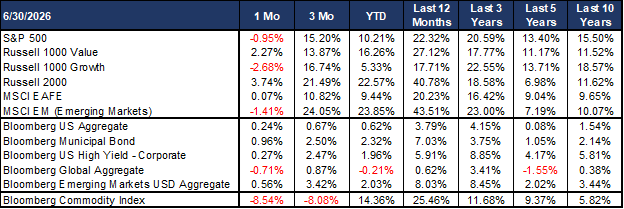
The first half of 2026 saw continued strong equity performance despite geopolitical stresses. Asset class diversification continues to benefit diversified investors, as small caps, emerging markets, and commodities all clocked higher returns than the S&P 500’s solid performance of more than +10%.
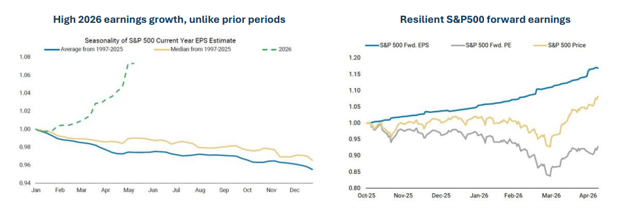
Earnings growth remains extremely robust (20%+ YoY) and we have seen some of the strongest upward revisions to corporate earnings in recent history, far in excess of the 30-year average.
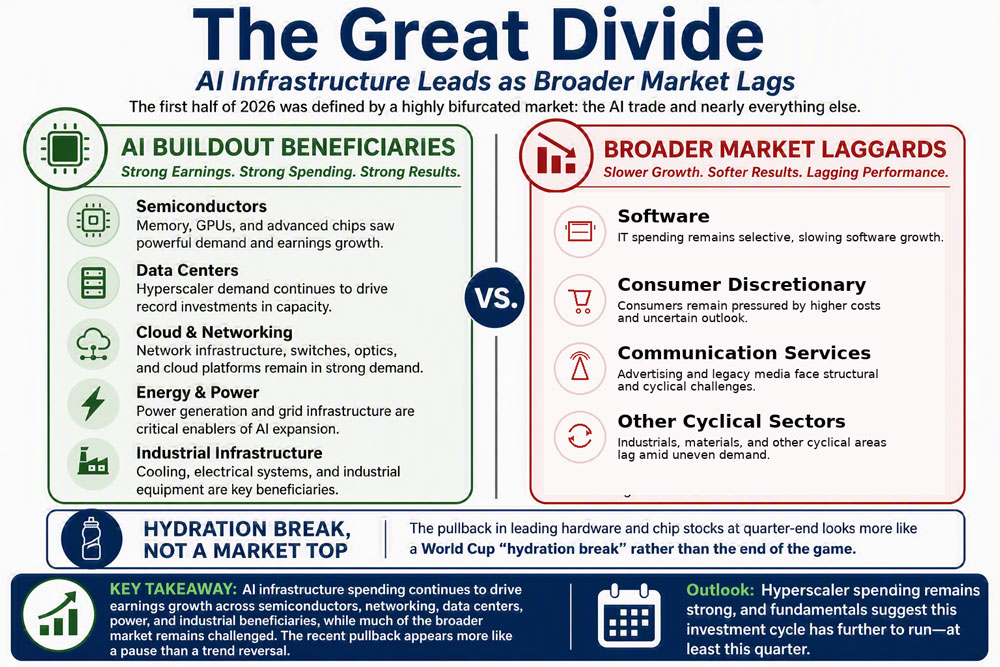
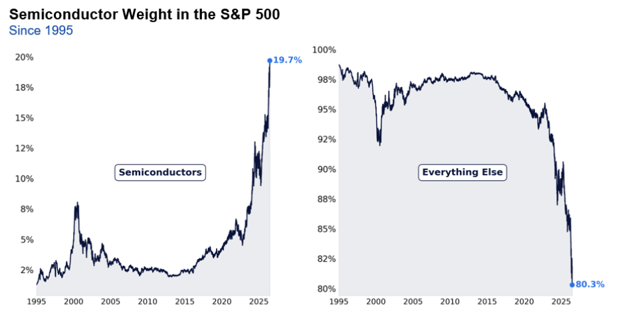
In the first half of 2026, we had a highly bifurcated stock market: there was the AI trade and everything else. The strength in hardware companies that make semiconductors (especially cyclical, historically low-margin businesses like memory chips) and companies that provide other tech hardware and semicap equipment persisted in 2Q, as did the weakness in software. Many investors came into the year anticipating a further bull market in AI, but those who expressed that opinion solely via the hyperscaler tech companies and/or Nvidia (ignoring the broader tech hardware space) were left frustrated. The hardware and chip companies that ripped the most in 1H pulled back sharply into quarter-end. While it looks tempting to “sell in May and go away,” as the market adage goes, the current fundamental backdrop looks more like a World Cup “hydration break,” as opposed to a lasting market top.
In short, the run-up in these areas is supported by strong earnings growth, which shows no signs of letting up because the hyperscaler spend shows no signs of letting up. It will at some point, but we don’t see that happening in the near-term. As we can see in the chart below, comparing the earnings revisions and stock performance of various stock market sub-sectors, “one of these things is not like the others.”
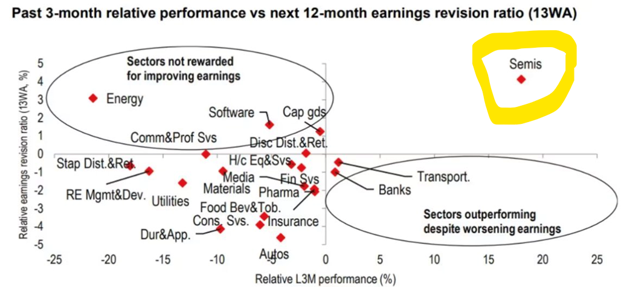
That said, the growth of semiconductor stocks versus the rest of the market certainly reached some extreme levels in 2Q; as a result, we have trimmed some of our exposure to AI “picks and shovels” companies.
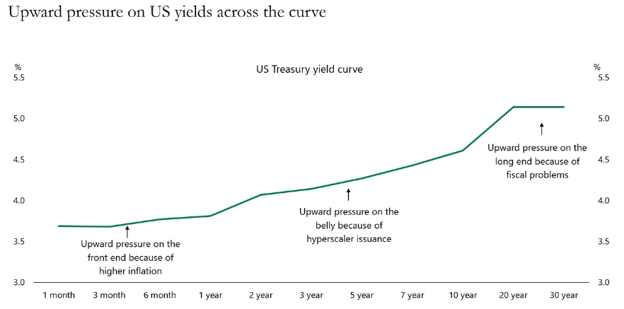
In fixed income, market fundamentals continue to support a “higher for longer” rate environment, with little evidence that the backdrop is likely to change in the near-term. We do not foresee a massive spike in rates from here, nor a return to 3% mortgage rates and 0% money market yields. This environment creates solid opportunities for patient fixed income investors to lock in attractive yields, but the path to quick capital gains (i.e. much lower rates) is not a risk, in our view. As the chart below illustrates, there are multiple reasons for this:
- Short-term rates are unlikely to fall because inflation remains sticky with low probability the Fed will cut rates in the near-term. Until core inflation decisively moves towards 2%, we do not expect newly-minted Fed Chair Kevin Warsh to lower rates.
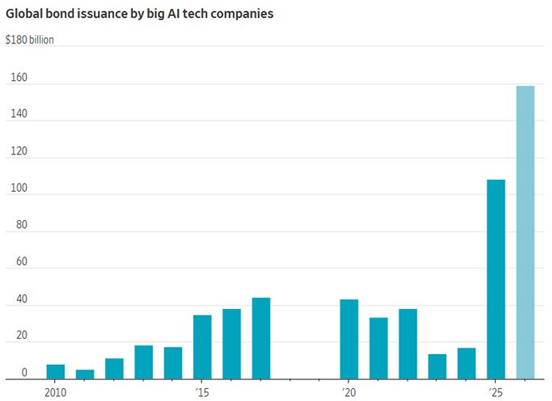
- The “belly” of the yield curve (3-7 years) is unlikely to fall for supply and demand reasons: hyperscalers are issuing massive amounts of debt to finance their AI spending. That spending is expected to remain high through at least 2028, so increasing issuance will be needed. Year-to-date, the impact of hyperscaler debt has pushed total investment-grade bond issuance higher 33% year-on-year.
- And the very long end of the yield curve (20 years and beyond) is unlikely to fall because the US fiscal situation remains long-term unsustainable: deficits as far as the eye can see. Until Washington gets serious about reducing the deficit, this is unlikely to change.
That's a Lot of Paper
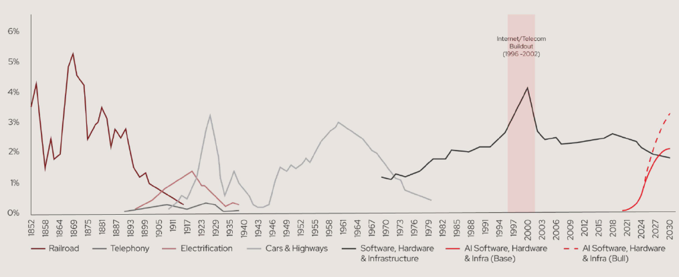
Zeroing in on the second bullet point above, we think it’s important for investors to grasp the scope of the investment going into AI, and the ripple effects that has on markets and the economy. As we see in the chart below, the scale of AI-related spending (most of it on datacenters and the chips that go in them) is on par, in terms of economic impact, with the largest infrastructure buildouts in US history – i.e. the railroads, the interstate highway system, and the internet/telecom system.
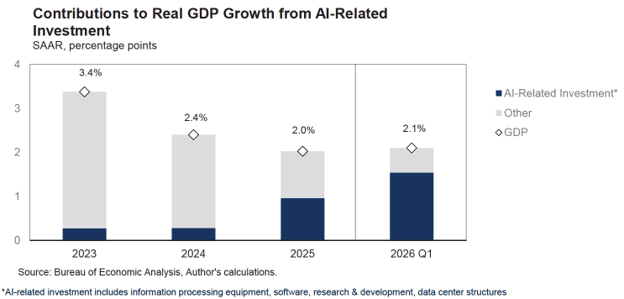
As a result, AI-related investment made up about half of incremental GDP growth in 2025 and will make up closer to 75% in 2026.
This spending does not occur in a vacuum. As we discussed last quarter, it has downstream impacts on electricity generation, energy prices, engineering and construction firms, and a wide swath of other “real economy” industrial and service businesses. Importantly, the money to fund this spending has to come from somewhere. The “hyperscaler” global tech companies that are doing this spending (Alphabet, Microsoft, Amazon, Meta, Oracle) are reinvesting their cash flows. This is a big shift from large balances leading to meaningful share repurchase activity. They are also increasingly issuing debt to finance this investment (Oracle being the foremost example). This spike in debt issuance relates back to our second bullet point above. As Mike Arnold, our head of Fixed Income, succinctly put it recently: “that’s a lot of paper.”
These companies are also issuing equity, Alphabet being the most recent example. This is a big turnaround, as the hyperscalers historically had been buying back their own stock (accretive to earnings per share). Now they are issuing shares (dilutive to EPS). Over the past 10 years, S&P 500 companies bought back about 2% of their shares per year. This “buyback yield” has been an underappreciated source of returns for equity investors. Now, that yield threatens to flip negative as companies suspend buyback programs and new companies IPO, SpaceX being the most recent example. In our view, more companies may choose equity financing over debt, rather then jeopardize their investment-grade ratings.
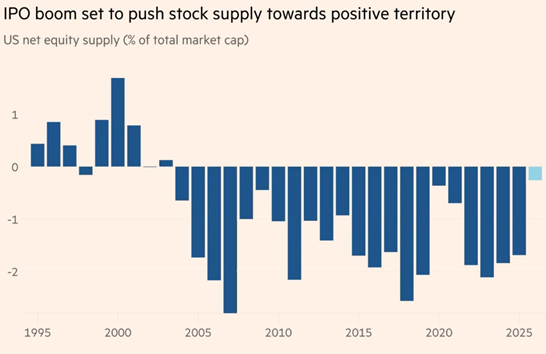
Bottom line: the promises made by the big tech companies to build out our AI future require a lot of money. That money requires the issuance of a lot of debt and/or equity. The private AI companies that built the foundational models will also be coming to market, issuing shares to the public (Anthropic, OpenAI). The capital to buy these securities has to come from somewhere. While we have yet to see a tipping point for the cost of corporate borrowing or equity investor risk appetite, the simple issue of rising supply relative to demand implies a marginal headwind to asset prices.
Our fixed income holdings are tilted high quality and short duration, under the view that attractive all-in yields can be realized without taking on excessive interest rate or credit risk. We are watching closely for the inevitable day when borrowing costs rise and credit spreads widen, creating a more target-rich environment within corporate credit. For now, we remain in a credit selection environment where investors need to be sure they are being compensated for the risk they are taking.
3Q26 Outlook: The Revenge of the Old Economy?
We enter 2H26 with a new Fed Chair distinctly different in style from any in the past 30 years. Where Bernanke and subsequent Fed Chairs pushed for more transparency and “forward guidance,” Kevin Warsh has made clear that he doesn’t think such oversharing is helpful to markets or investors. While some might argue this will add uncertainty and therefore volatility to markets, our view is that a Fed that is not constantly adjusting and sharing needlessly specific economic projections is a credible Fed. A credible Central Bank is a good thing for investors and markets. Chairman Warsh has also tasked a group, led by former Bank of England Chair Mervyn King, with reviewing and potentially overhauling the data that the Fed uses to make its decisions (as well as other components of the Fed decision-making and communication process). We do not foresee any material changes to Fed policy until that task force has completed its job, which will like (and conveniently) be after the mid-term elections.
Coming into the year we expected the economy to run fairly hot. Despite the fallout from the Iran war, it more or less has, with levels north of 2% real GDP growth for 1H26 and likely to stay there for the remainder of the year. At the same time, we worried that inflation pressures could lead to a hawkish Fed in 2H26. Unfortunately, the Iran war pulled those fears forward. The new Fed Chair’s preferred inflation measure, the Dallas Fed Trimmed Mean PCE inflation rate, printed around 4% (excluding food and energy) in May.
An environment where monetary policy is net tightening, growth is accelerating, and inflation remains sticky has historically proved beneficial for “value” stocks, emerging market (EM) equities, and commodities. We are overweight EM and own commodities in client portfolios. We are a “quality growth” shop when it comes to stock-picking, so “deep value” companies without secular growth tailwinds are not where we invest. But it is interesting to see the “growth” linchpins of portfolios for many years reclassified into “value” by the index/benchmark providers. Amazon is now the largest weight in the Russell 1000 Value Index, and Microsoft is classified as 50% Growth / 50% Value. Beyond these tech/communications stalwarts however, we have been adding to healthcare, energy, consumer staples, and other “old economy” names that sport growth rates of 3-5x the broader economy (shouldn’t that make them growth stocks???) but valuations (P/E ratios) less than twice their growth rate (their PEG ratios are below 2). So, “value” in this context does not necessarily mean low-growth companies with low volatility (like Proctor & Gamble or Otis elevator). Nor does it mean cyclical companies with optically cheap multiples (like Exxon Mobil). For instance, a company like Stryker (SYK) is growing their medical equipment business in the low-double-digits, their margins are expanding, and their cash flow return on invested capital runs in the mid-teens. The business has a dominant position in their end markets and is supported by demographic tailwinds. Yet the stock trades less than 20x next year’s earnings, below the broader market. This is one example that highlights how we are approaching stock selection in the current environment.
As we have been writing for many quarters, the AI platform shift will be a multi-year secular trend with many ramps and drops, and many sub-sector themes under the hood. We have already seen this in 1H26. While we have trimmed exposure to some of our AI winners, we by all means advocate having exposure to this megatrend. That being said, the extreme swings in sentiment that have caused investors to ignore many high-quality companies have created increasingly compelling pockets of value and margin of safety into which we continue to allocate capital.
In all, the most important markets story of 1H26 was perhaps not the macro shock of the Iran War, but the continued structural shifts going on within the equity markets. Market concentration remains near historic highs. “Value” indices now contain “Magnificent 7” stocks like Meta and Microsoft, while “Growth” indices now contain semiconductor stocks that trade at 10x earnings and semiconductors now comprise a whopping 30% of that index. Relentless retail buying and endless ETF products now seem more a feature of modern markets than a bug, for better or worse. Growth and Value have always been artificial constructs that make little sense to us (we want to buy growing companies at a discount to their intrinsic value), but the changing landscape of equity markets makes them even more so.
Investment Implications
Coming into the year, we observed a macro backdrop that looked conducive to a strong year for the US economy but with sticky inflation likely to result in a more hawkish Fed, perhaps not as great an environment for equities. While we are not advocating to “sell in May and go away,” we have been incrementally rotating from some of the AI high-fliers that have led the market over the past few years into high quality businesses that have been largely ignored by investors. In our view, these investments offer compelling value and should hold up better in a market correction than the broader indices. We think the most likely path forward for markets is modest Fed tightening (though perhaps not as much as priced by bond markets), higher but volatile global stock markets, a stronger dollar, and a flatter yield curve. But tail-risks exist, especially around inflation and geopolitics. Therefore, diversifying assets like commodities, as is almost always the case, continue to have an important place in portfolios. The macro backdrop is not ideal for bonds, however all-in yields remain very attractive, as levels significantly higher than the past 16 years. That same backdrop should continue to be supportive for commodities and other real assets.
We hope you are enjoying the Summer (and the World Cup). Please reach out to me or your SYB Team if we can be of assistance or you have questions.
We provide the information in this newsletter for general guidance only. Future results may differ materially from projections. Past performance does not guarantee future results. It does not constitute the provision of legal advice, tax advice, accounting services, investment advice, or professional consulting of any kind. The information provided herein should not be used as a substitute for consultation with professional tax, accounting, investment, legal, or other competent advisers. Before making any decision or taking any action, you should consult a professional adviser who has been provided with all pertinent facts relevant to your particular situation. The information is provided “as is,” with no assurance or guarantee of completeness, accuracy, or timeliness of the information, and without warranty of any kind, expressed or implied, including but not limited to warranties of performance, merchantability, and fitness for a particular purpose.