


2026 2Q Outlook: The Singularity Will Most Certainly Be Televised
Fri, 04/17/2026 - 16:00 Wealth management

by John M. Fidler
Chief Investment Officer | (502) 259-2543 | John.Fidler@syb.com
2026 1st Quarter Review
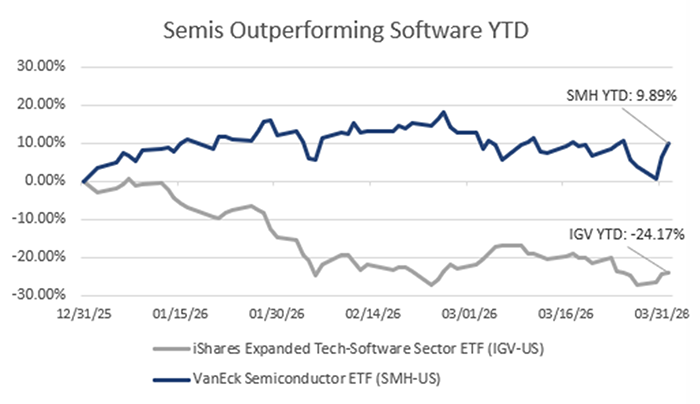
In January and February, stock and bond markets rose modestly, with International equities continuing to outpace the US, in line with the theme of global diversification we have long highlighted. (This has not materially changed, we continue to have conviction that globally balanced portfolios will outperform US-centric ones over time.) So, markets were placid on the surface for the first two months of 2026, but we saw significant turmoil under the hood in the form massive sector rotations. Namely, software performed terribly (e.g. Microsoft was nearly 30% below its October highs at the end of February) while many AI-related companies, particularly those in the hardware space, performed well (e.g. ASML was up nearly 40% over the same period).
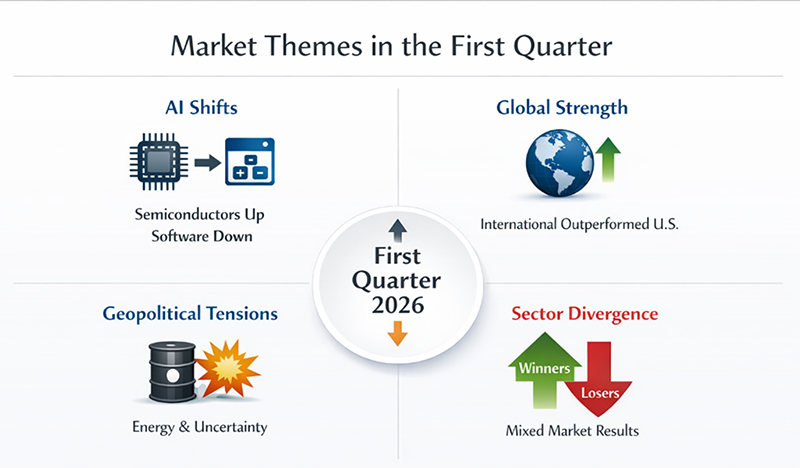
Fears that AI will “eat the world” drove (and continue to drive) these moves. The concern for software investors is that customers will begin using large language models (LLMs) like Anthropic’s Claude, among others, to build software that can replace everything from Docusign to Customer Relationship Management systems (CRMs) to Microsoft Excel, even Cybersecurity software. More on this later, but in preview we think the pendulum has likely swung too hard in certain areas of this violent sector rotation. This current market dynamic is shown below (software stocks in gray, semiconductor stocks in blue).
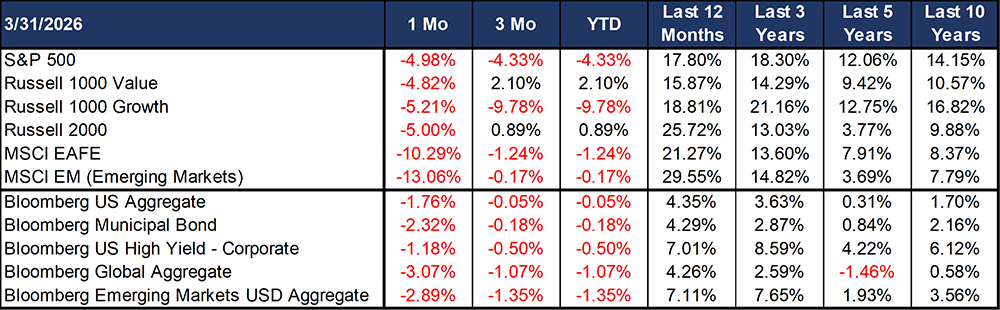
The outbreak of war in the Middle East at the beginning of March changed the market backdrop dramatically and threatens to slow the global economy. As a result, 1Q26 produced a short-form rendition of the 2022 experience: Stocks fell during the quarter (S&P 500 -4.3%) with all of that decline occurring in March. Bonds also fell, providing little safe haven (10-year Treasury yields rose modestly during the quarter). The only bright spot for diversified investors was commodities, as the Bloomberg Commodity Index rose 23%, led by a 77% increase in WTI crude oil during the quarter. This oil price spike and attendant commodity supply chain bottlenecks have increased stagflation risks and muddied the waters for our expectation of a strong global economy in 2026.
Welcome to the Future1
“We have entered the Singularity” – Elon Musk, January 2026
“The Singularity” commonly refers to the point at which artificial intelligence (AI) surpasses human intelligence, triggering an uncontrollable “intelligence explosion” of self-improving technology, rendering future technological, social, and physical changes unpredictable. By definition, this could lead to dystopia (think: Huxley’s Brave New World), utopia (think: Huxley’s Island), or anything in between. (Unsurprisingly, everyone knows Brave New World, but almost no one knows Island: dystopian visions of the future sell, utopian ones do not.)

With apologies to Gil Scott-Heron, the AI revolution has been and will continue to be much-publicized, much-televised, and much-debated. A blog post published in late February entitled “The 2028 Intelligence Crisis” garnered much heated discussion, including a write-up in the Wall Street Journal (among other publications) and was the talk of finance circles for weeks. If you haven’t read it, I encourage you to do so, though you may want to pour yourself a stiff drink beforehand.2
It paints a bleak picture of a dystopian future in which artificial intelligence (AI) renders the professional skills of knowledge workers obsolete, unemployment rises above 10%, and white-collar professionals see their earnings power (and the 75% of discretionary consumer spending they account for) structurally impaired. With corporate earnings (outside of a few AI winners) in freefall, the government sees tax receipts collapse at the same moment they need more money to transfer to households. Stagflation ensues and the social fabric frays. The knowledge economy is turned on its head as machine intelligence becomes a substitute across a growing range of skilled jobs that previously required an expensive education.
This is an extreme vision of the near future. In the author’s defense, he is quite clear that this piece was a thought experiment, and just one outcome among a wide range of outcomes when it comes to AI. But these types of thought experiments are important, because investors are, in our view, a long way past the point of being able to ignore AI as an investment theme or dismiss it as a fad or bubble. While 2028 might not be a doomsday world (spoiler: we don’t think it will be), there is almost no plausible scenario in which we look back in 2028 and say “all that AI stuff wasn’t a big deal, everybody overhyped it.”
An insightful investor we regularly read recently wrote something we agree with wholeheartedly:
“We see most of the world is looking for how AI underdelivers, underperforms, fails even. It’s inexplicable. We’re living through the Singularity and does that mean everything goes straight up to the right? No. But do you think we’re going to be on the other side of the Singularity, the event horizon, and we’ll look back and say, it was smart to have spent the whole singularity searching for bubbles and talking yourself out of taking real risks?”
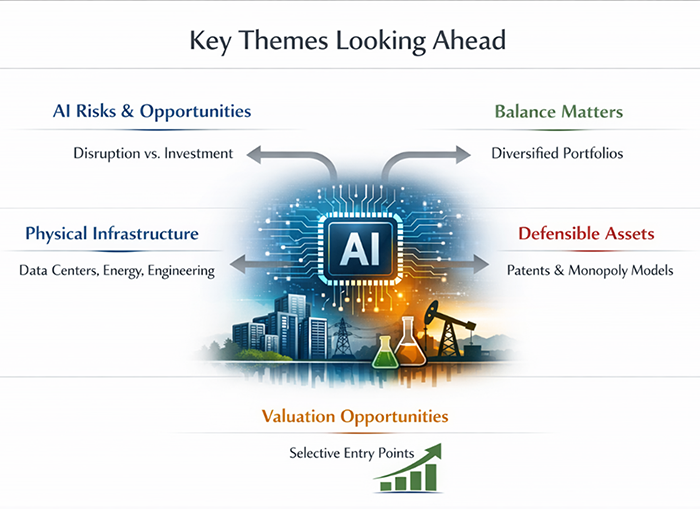
At Stock Yards, we are confident enough in our analysis of ongoing secular themes to believe that investors should have meaningful exposure to AI beneficiaries (including those that would survive or even prosper in the “Citrini scenario”). That said, we are realistic enough about our limited ability to predict the future that we want portfolio balance and diversification. While the importance of AI is clear, the premise of our AI view is based on (1) not ALL “AI stocks” will “go straight up to the right” and (2) what AI means for the world and markets in 2028, or even the end of 2026, is impossible to know with certainty.
First, we inherently push back on the notion that the AI platform shift necessarily means mass layoffs, perhaps even in vulnerable areas like software. Something called Jevon’s Paradox, proposed by an economist in the 1860s, states that as technology increases, the efficiency with which a resource is used, and therefore the total consumption of that resource increases rather than decreases. This explains why building more highway lanes fails to solve traffic congestion and why making cars more energy efficient results in more miles driven. It also helps explain why major technology shifts like the Industrial Revolution, the personal computer, or the Internet ultimately led to more jobs in some occupations rather than mass layoffs. Perhaps this line of thinking explains the following chart:
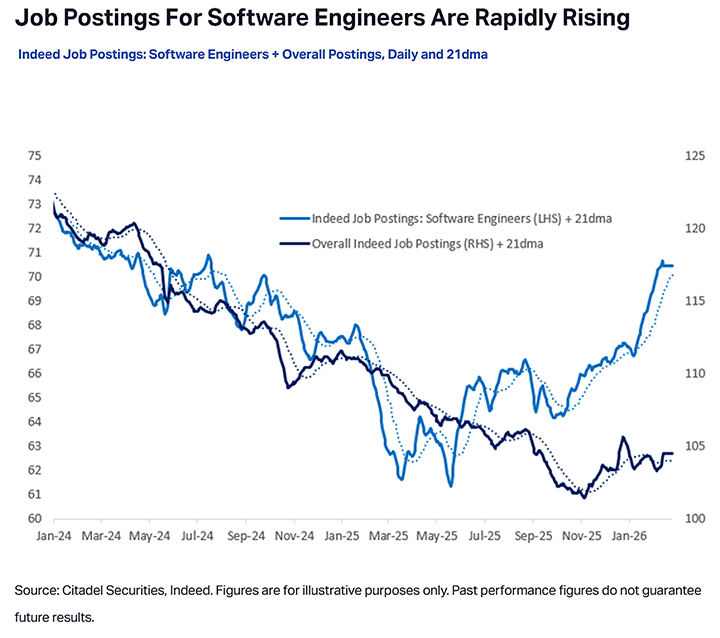
This isn’t to say AI won’t cause disruption to existing business models (including software). It has and it will. Our view is that the AI revolution will play out in a slow-moving rotation. A recent analog would be in the 2000s (before cloud computing), when Amazon’s market cap growth was roughly equal to the sum of market cap losses for bricks and mortar retailers for an extended period. Yes, if you worked at Barnes & Noble, your job was at risk. But this massive shift in retailing did not lead to widespread aggregate unemployment.
If forced to guess, we think the capital-light business models that have been rewarded for the past three decades are at risk, at least in terms of the valuations awarded to those businesses. This is particularly true of those businesses with softer loyalty or network effects (something like Docusign is an obvious example). But much of the software industry is in an interesting spot – they have the potential to survive for a long time if they adapt to AI and neutralize their need for replacement. Those that adapt (like Wal-Mart did to the e-commerce threat posed by Amazon) or possess true “moats” as enterprise systems of record (e.g. Oracle, SAP) or providers of mission critical infrastructure (e.g. ServiceNow, Palo Alto Networks) will continue to be winners. Those that don’t will be roadkill.
Pockets of financial services risk quick displacement, such as payments, insurance brokers, and real estate-heavy banks, which we believe will struggle to compete with digital-native competitors. However, boutique and community banks that provide value-add functions and high-touch customer service will likely fare far better than large banks, with the possible exception of JP Morgan, which has the unmatched capital and scale to adapt (but also a stock valuation that reflects this).
Where We're Going, We Need Roads
Paradoxically, an increasingly digital world requires a lot of analog stuff. Not just microchips, but lots of plants, property, and equipment. Infrastructure investment will continue to mean roads and bridges, but also datacenters and power plants and LNG terminals. AI infrastructure requires hard assets like semiconductors and the datacenters that house them. Building and operating those datacenters requires engineering and construction know-how to build them, and complex systems (that cannot go down at any time, for any reason) to power and cool them. While AI will displace some jobs and businesses, and transform many others, it will make the jobs and businesses that can’t be disrupted, especially those essential to powering the “singularity,” even more scarce and valuable.

Industrial companies with more standardized procedures should see a deceleration in growth (and a peak in their stock price) before those that require bespoke planning or skilled labor where humanoid robots will be necessary. So, widget makers (e.g. companies that manufacture gas turbines for power plants) should peak well before the construction crews installing them (e.g. engineering and construction companies). Patents and monopoly business models will be an even more important asset than ever. This favors select pharmaceutical, financial services, utility, and energy companies.
Our current equity portfolio positioning overweight utilities and midstream energy companies like Cheniere Energy, with adequate exposure to the picks and shovels of AI hardware and Hyperscalers, along with overweights to healthcare companies with durable competitive advantages (wide “moats”), reflects these views.
2Q26 Outlook: Hot Economy Thesis Wounded, Not Dead
Getting down to our views and what we are doing in portfolios, much of this commentary will be familiar, if not boring, to long-time readers: Build diversified portfolios beyond just US large cap stocks and core US bonds. Own international assets. Own commodities, non-correlated alternative investments, and other cash-flowing inflation hedges for diversification. Diversification allows investors to take advantage of single-market volatility, instead of being shaken out of the market by it. Seek out pockets of value and inefficiency in the markets.
So, what does that mean for how our views (and client portfolios) are evolving? Coming into the year, our core thesis was that global fiscal stimulus (especially the OBBB in the US), along with a reversal on tariffs and an accommodative Fed, would be pro-growth. Massive AI spend would be stimulative to the economy and generate ROI for the hyperscalers, without the labor dislocation envisioned by Citrini. Combined with the possibility of further fiscal stimulus ahead of the mid-term elections, we saw a hot economy in 1H26, but the potential for stagflation fears in 2H26. In all, we thought this implied a decent year for stocks, but a better year for the economy. Most of these dynamics are still in place. We also discussed the high likelihood for 2026 to provide an excellent buying opportunity for stocks (i.e. a big sell-off followed by a big rebound, just like last Spring). We believe this is likely playing out now.
So, what has changed since the outbreak of war in the Middle East?
- Higher oil prices and lower stock prices are not constructive for consumer spending, as this means fewer dollars can go to discretionary spending, and a weakened (or even negative) wealth effect.
- Central Bank policy expectations have taken a U-turn. Prior to the war, markets were pricing in two rate cuts in 2026. As of this writing, they are not pricing in another rate cut late next year, and pricing a greater chance of a 2026 rate hike than a rate cut.
- Wars aren’t cheap and the additional government deficit spending to finance the war will not help a debt market that already has to absorb massive corporate issuance to fund AI capex and massive Treasury Bill issuance to fund the deficit.
As a result of all this, financial conditions tightened to the most restrictive levels since last Spring’s Liberation Day market sell-off through quarter-end.
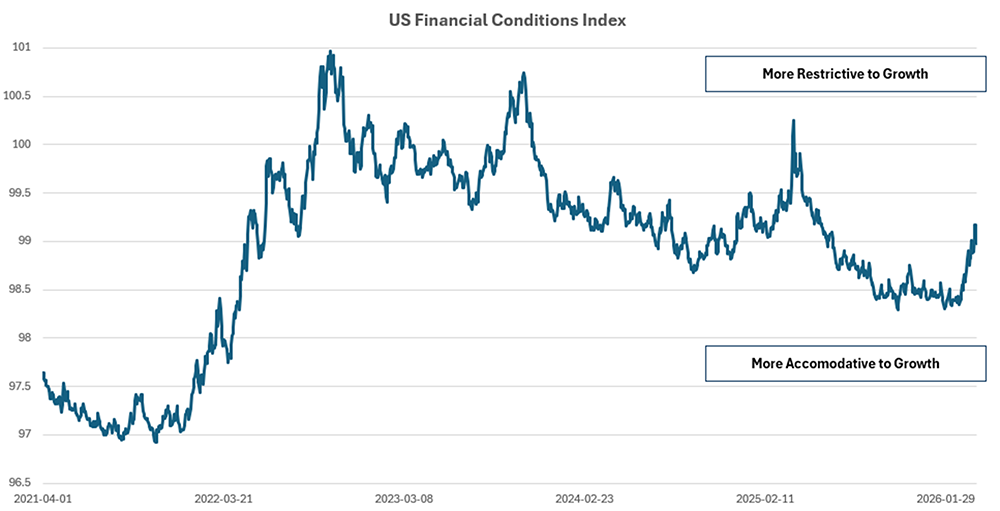
While markets rallied and financial conditions loosened materially in early April as a ceasefire was announced and discussions to end the war commenced, it remains unclear what the ultimate outcome will be. The three bullet points above remain relevant, barring a total capitulation by the Iranian regime.
Investment Implications
We don’t pretend to have any expertise in geopolitics or military strategy. Nor do we pretend to have any special insight into the psychology of the major players in the Iran War. In our view, it’s not even possible to know with certainty what “end state” for the war would be best for investors, let alone the path for how we get there, nor how markets will react to each step of that path. Rather than bet on geopolitical or even economic outcomes, our job is to build portfolios that generate reasonable returns, with reasonable risk, across a broad range of scenarios.
That said, as economic observers and analysts, we do not think the global economy is slowing massively. And as market practitioners, we have observed the market’s tendency to extrapolate the worst when negative policy decisions unfold (e.g. last April). The world currently seems random, with headlines and markets driven by tweets and unpredictable actions by irrational actors. Literally, the fog of war.
However, throughout history, the simple math of buying cash flows when they are cheap eventually bears fruit and will continue to. We see a lot of high-quality businesses now trading at fair, if not attractive, valuations. All the trite market cliches apply here: buy when there is blood in the streets, be greedy when others are fearful, don’t put all your eggs in one basket, etc. Since the beginning of 2025, corporate earnings have grown nearly 20% (and are forecast to grow 16% this year) and interest rates have fallen. Massive fiscal stimulus is hitting consumer and corporate balance sheets as we speak, in the form of tax refunds and accelerated depreciation. Therefore, we see fundamental conditions for stocks as substantially better today than they were at the beginning of 2025. Yet the S&P 500 is just 14% higher (multiples have contracted). We see a lot of fear and an increasing number of opportunities. All the usual ironclad rules around diversification and prudence still apply, and we are certainly not positioning client portfolios for “maximum risk.” The March malaise could certainly continue into the 2nd quarter, and we doubt that “the low” is in for stocks in 1H26. However, we think any further meaningful decline in assets, especially US equities, is likely a good buying opportunity, and we are therefore biased to add exposure to high quality businesses that have been sold off for (in our view) spurious reasons, as opposed to reducing exposure to manage risk.
1 Special thanks to Steven Gray and Spencer Joyce for their substantial assistance in this Outlook
2 Read the full essay here: https://www.citriniresearch.com/p/2028gic
We provide the information in this newsletter for general guidance only. It does not constitute the provision of legal advice, tax advice, accounting services, investment advice, or professional consulting of any kind. The information provided herein should not be used as a substitute for consultation with professional tax, accounting, investment, legal, or other competent advisers. Before making any decision or taking any action, you should consult a professional adviser who has been provided with all pertinent facts relevant to your particular situation. The information is provided “as is,” with no assurance or guarantee of completeness, accuracy, or timeliness of the information, and without warranty of any kind, expressed or implied, including but not limited to warranties of performance, merchantability, and fitness for a particular purpose.