


Market Outlook: Q1 2024
Fri, 01/19/2024 - 10:55 Wealth management

Chief Investment Officer
(502) 259-2543
John.Fidler@syb.com
2023: Year in Review
2023 will go down as a good year for investors and a year where almost all forecasters got it wrong.
Coming into 2023, financial conditions were somewhat restrictive. The economy was slowing and inflation remained at a high enough level to guarantee further interest rate hikes. In March, we saw the collapse of several large US banks, seemingly proof positive that Federal Reserve rate hikes were beginning to break things in the financial system. Following the failure of Silicon Valley Bank and several others, it was difficult to imagine a scenario where the economy surged and inflation declined.
However, that is exactly what happened. Thus far in this economic cycle, the Fed seems to have achieved its much-heralded “soft landing” scenario; inflation has steadily fallen, in line with our expectations coming into the year. Personal consumption expenditures – long considered the Fed’s favored inflation measure – dropped to 3.2% year-on-year in November (and under 2% over the prior 6 months) versus 4.7% inflation a year prior.
But economic growth proved resilient despite aggressive Fed tightening and “higher for longer” interest rates. This was in part due to (1) excess savings accumulated during COVID-19 being spent down, boosting consumer spending, and (2) massive government budget deficits supporting fiscal stimulus. With these factors buoying growth, real GDP grew 4.9% in 3Q24, the largest advance since 4Q21. Liquidity conditions have also been helped by the Treasury choosing (at the end of October) to finance the deficit mainly with short-term T-bills (as opposed to long-term bonds). As a result of this “Goldilocks” scenario, asset prices soared, with S&P 500 returns of over 26% in 2023 and the Nasdaq gaining nearly 45%.
As we discussed throughout 2023, much of these gains were concentrated in the so-called Magnificent 7 mega-cap growth companies which were up an eye-popping 76% for the year. As the year ended, the market rally did broaden out, and the Russell 2000 Index of small companies gained 17% for 2023. The bond market avoided an unprecedented third consecutive calendar year of declines thanks to a strong fourth quarter rally with the Bloomberg Aggregate Bond Index returning 5.5% for 2023, nearly 4% in December alone given the Fed pivot on rates discussed below.
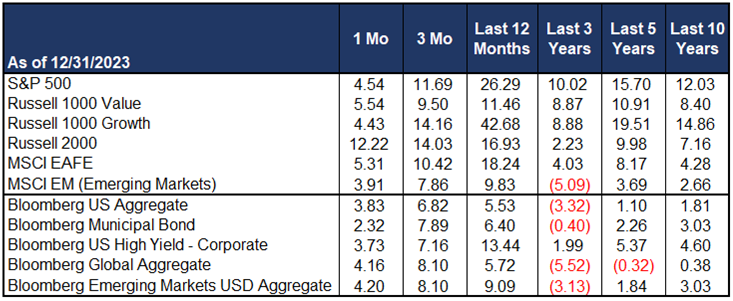
There was much to cheer as we exited the holiday season and entered the New Year. We have been preaching diversification and reasonable alternatives to the equity markets since late 2021. This strategy served clients well in 2022, but not in 2023. But the net result leaves clients who stayed the course in a reasonable place with the value of their portfolios roughly where they stood at the end of 2021. More on that later.
Obviously, the current happy state of affairs, with portfolios at or near all-time highs, masks a lot of volatility over the past two years. Recent years have been a wild ride, from the stagflation-induced all-asset bear market of 2022 to the artificial intelligence euphoria of 2023, only to end up back where we started.
This reminds us of an apocryphal investment tale of a client who didn’t check his statements from the Spring of 2022 until recently. Upon meeting with his advisor at year-end, and seeing his account value a touch higher than it had been at the end of 2021, he remarked “You work in a very boring business.”
Don’t Fight the Fed?
Fed Chair Jerome Powell spent much of 2023 warning market participants that the Fed’s inflation fight was far from over. According to the Fed, monetary conditions would remain restrictive with the mantra becoming “higher for longer.” This catchphrase implied higher interest rates than in the past, for a longer period than markets were expecting. Repeatedly, fixed-income markets jumped the gun in pricing in rate cuts. But each time this happened, the Fed pushed back forcefully, adjusting their dot plot of forward rate expectations higher and warning investors that further rate hikes could be required.
But in December, the Fed made a profound and surprising about-face. This so-called Fed pivot was the equivalent of a declaration of “mission accomplished.” Literally overnight, the Fed went from signaling a willingness to hike rates again to signaling the desire to cut rates at least three times, starting as soon as March 2024.
So, will the Fed pivot go down as a moment of victory for the Fed? Has the central bank finally broken the back of inflation? Or will this go down as a financial markets analog to another time a US leader publicly declared “Mission Accomplished”?

Outlook 2024
A year ago, despite a “Santa Claus rally” in equity markets, we felt the evidence pointed to risks of a hard landing being underpriced. Those risks have yet to materialize. Today, economic data indicates that the decision to declare victory over inflation is likely to significantly complicate the path to the Fed’s 2% inflation target. At the same time, it will likely open the door for new investment opportunities in 2024.
Looking ahead, the trend in economic data is weaker, but growth remains positive. Deficit spending is unlikely to abate, especially in an election year. Household wealth, while lower than when the Fed began raising rates, is almost 30% above pre-COVID levels. However, the availability (and cost) of credit remains restrictive and the trend in job creation is weakening.
Consumer COVID savings are nearly exhausted and the lingering effects of government stimulus are waning, not to mention the end of the student loan payment moratorium. Along with still-high interest rates (e.g. mortgage rates above 7%), we see continued weakening of the consumer likely in 2024.
The labor market remains robust. While monthly job growth has slowed from around 600,000 new jobs per month when the Fed started hiking rates to around 150,000 today, job growth remains solidly in positive territory and wage inflation remains above pre-COVID levels.
S&P 500 earnings growth was a relatively anemic 3% in 2023. Consensus expectation is for double-digit growth in both 2024 and 2025, we remain skeptical that this is an achievable bogey.
As outlined above, inflation has fallen sharply since 2021, but the “last mile” in getting to the Fed’s 2% target is likely to prove difficult, especially given the loosening of financial conditions inherent in the Fed pivot.
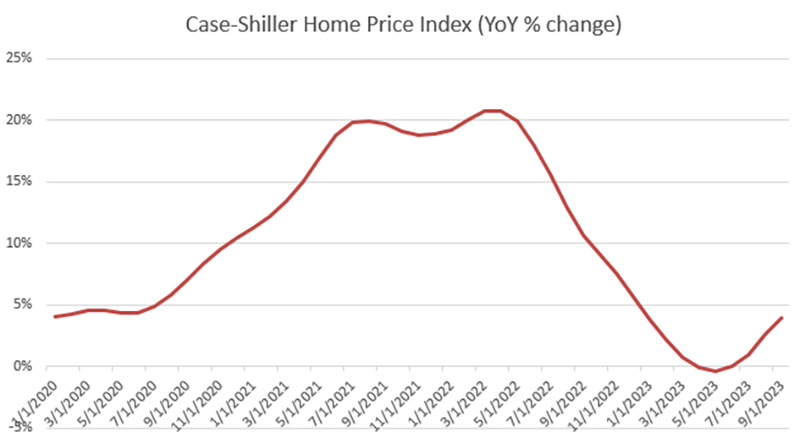
Importantly, the housing market looks to be improving. Once consigned for oblivion, residential real estate rebounded when mortgage rates started to decline during October. Housing is often a leading economic indicator and the current bounce back is a positive sign.
In all, the economy continues to be resilient. Nevertheless, the odds of the US falling into recession during 2024 are certainly higher than what is currently baked into asset prices. The New York Fed, using a model based on the shape of the yield curve, puts the odds of a recession by year-end at around 60%. We also see upside risks to inflation for the first half of 2024 as the market digests the Fed pivot. Further, aggressive changes to Fed interest policy can take a considerable time to impact the economy more broadly, creating downside risk for economic growth in the second half of 2024. This will also play out against the backdrop of a Presidential cycle involving a sitting President, historically a calendar year when stock markets perform well.
Push Me, Pull You
As we evaluate how the economy will evolve in 2024, it’s important to note that with the substantial rally in stock and bonds markets in 4Q23. Financial conditions are now actually looser than when the Fed began to raise rates in 1Q22.
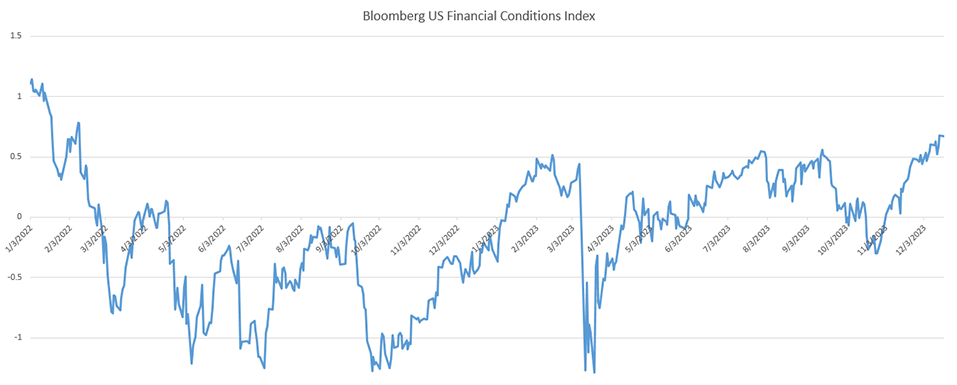
As we talked about last quarter, while the Fed began raising short-term rates in spring 2022, we did not see long-term interest rates react meaningfully until summer 2023. It takes time (a long and variable amount of it) for monetary policy to filter through into the real economy. This is because rents don’t reprice every day, homeowners don’t move every year, corporate and household budgets aren’t revised every month, and corporations don’t refinance their debt every quarter.
Only in the last calendar quarter or so did we begin to see the impact of the 2022 and early 2023 rate hikes on the economy. In fact, we would argue that we still haven’t seen the full restrictive impact of rate hikes that occurred over the past 6-12 months.
After seven quarters of aggressive tightening policy, the financial markets seem to be convinced that the Fed has conquered inflation. Monetary authorities are confidently forecasting inflation to arrive at their 2% target in early 2024 and signaling policy cuts in the not-so-distant future. In response, financial markets are pricing in a virtually 100% chance of continued disinflation and a virtually 0% chance of a 2024 recession.
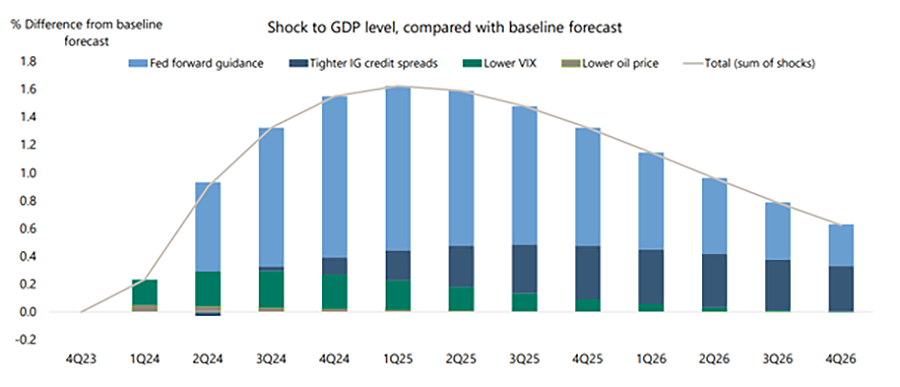
The problem with this rosy outlook is that the policy path signaled by the Fed is itself inflationary. Credit spreads, volatility, and oil prices are all relatively low. These favorable financial conditions combined with the rate cuts implied by Fed guidance would boost GDP by about 1.5% over the next year or two. Our view is that this level of monetary accommodation by definition puts a floor under inflation. A “no landing” scenario almost necessarily implies a run-rate for inflation above the Fed’s target, complicating the goal of getting to sustainable 2% inflation in the medium term.
Over the past year, we’ve explained how housing is both the biggest component of the inflation calculation and the slowest-moving. Even before any Fed rate cuts, housing inflation started to rebound. This resurgence complicates the Fed’s job and creates risks that they could be forced to stay more hawkish than they are signaling currently.
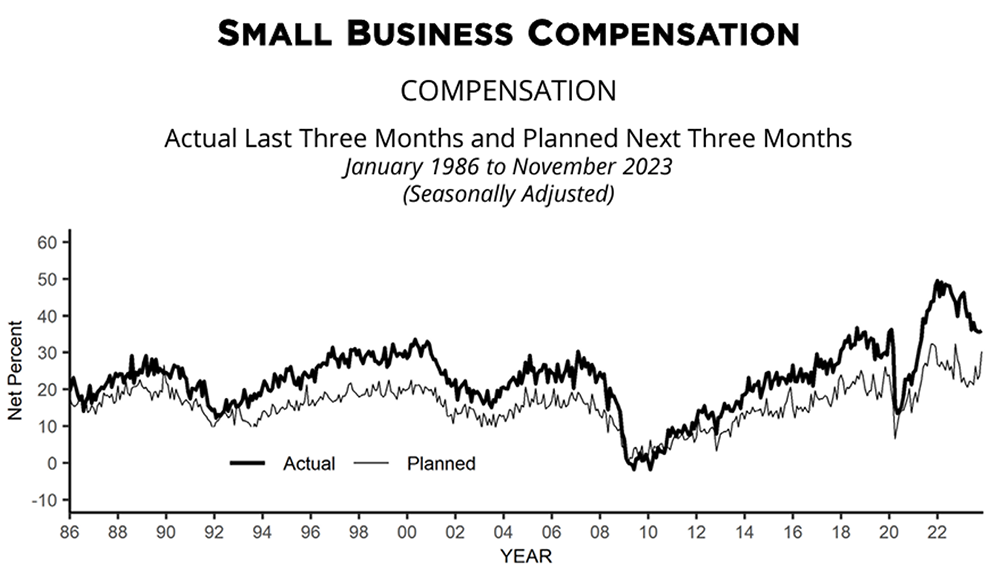
The same inflationary rebound is evident with wages. Wage inflation has been steadily falling since the Fed began hiking rates, but small business surveys now point to a rebound in compensation on the horizon. Again, this complicates the Fed’s mission.
Every Problem is an Opportunity in Disguise
Markets may well be right, and a “soft landing” could continue, but we are not sure investors are being adequately compensated to take on that risk. The S&P 500 stands at about 20 times 2024 consensus earnings expectations, which have fallen about 3% in the past few weeks. The 10-year Treasury sports a real yield of around 1%. Neither entry point is consistent with spectacular go-forward returns, though we see a bit more value generally in fixed income than equities at these levels.
So, where do we see opportunity in the markets? If the Fed is correct in its assessment for continued disinflationary growth, we should see interest rates continue to fall, financial conditions remain easy, and the economy should remain resilient. This would bode well, broadly speaking, for the 493 stocks not in the Magnificent 7.
Loose financial conditions should bolster merger and acquisition activity. Growth has been the most prized commodity for investors over the past year. Today, many smaller companies exhibit modest growth but have strong profitability and free cash flow creation that could prove attractive targets for both strategic and private equity buyers.
While we always focus on quality companies, we suspect 2024 will be a year, unlike 2023, where cash flow generation is prized over top-line revenue growth. All of these factors should provide a relative tailwind for smaller and mid-size cyclical companies trading at reasonable valuations relative to their intrinsic value. We have been adding to cyclical exposure in the industrial, utility, and energy sectors, especially companies set to benefit from infrastructure and other government spending. We also like international companies, especially emerging markets, which should benefit from dollar weakness if the Fed is indeed able to cut rates meaningfully.
Our view is that “higher for longer” is not dead. By this, we don’t mean that interest rates are going to 1970s levels. While the chance of a recession in 2024 is certainly greater than zero, the chance of a US debt crisis is zero. But the days of 0% money market rates and 3% mortgages are not coming back any time soon. A world where Fed Funds rates average 3% and 10-year Treasury yields average 4-4.5% isn’t great for borrowers, but it presents opportunities for savers. Despite the move down in rates in 4Q, our fixed income team continues to see opportunities to lock in reasonable (often tax-free) yields for clients for extended periods.
Alternatives
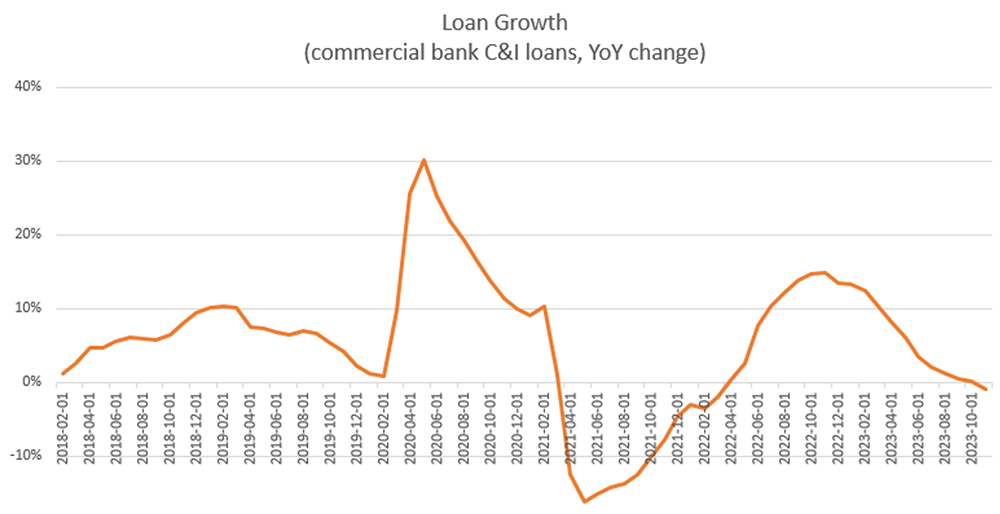
Outside of traditional stock and bonds asset classes, we continue to see opportunity in selected alternative investments. A continued stagnation in bank lending should continue to support non-bank lenders and create opportunities in private credit, creating chunky yields and relatively uncorrelated returns for investors.
Our non-correlated alternatives funds posted strong returns in both the growth environment of 2021 and the hot inflation year of 2022. A return to the “Goldilocks” market narrative in 2023 was a headwind for these strategies and they performed poorly last year. We believe this creates a good tactical entry point for these strategies for appropriate investors. Moreover, if the Fed can’t “land the plane” in 2024 and we get either a resurgence of inflation and/or a recession, these strategies should provide useful diversification.
To summarize, we think the Fed and the economy still have challenges ahead, and 2024 will be a year of push and pull between the lagged effects of prior monetary policy, including the Fed pivot, and the Fed’s present desire to get inflation (and rates) lower.
The key question for 2024 is whether interest rate increases in 2022-23 will be sufficient to get inflation back to 2%, particularly in the context of forward rate guidance. Could the Fed be prematurely declaring victory over inflation, forcing them to pivot again in the opposite direction during 2024?” Alternatively, if inflation does fall as fast as the Fed is forecasting this year, is the risk of a 2024 recession truly zero?
F. Scott Fitzgerald wrote that “The test of a first-rate intelligence is the ability to hold two opposed ideas in the mind at the same time, and still retain the ability to function.” It would be a mistake to wed ourselves too tightly to either view. Members of our investment team can make (and have made, in our often lively Investment Committee meetings) sound arguments to support outcomes raging from a hard-landing recession to a continued no-landing scenario in which we already experienced “the recession” in 2022. The important thing in developing our investment and risk framework for clients is to acknowledge that either scenario could happen, estimate what has already been discounted into markets, and select securities and construct portfolios accordingly.
In terms of dominant market narratives and drivers for 2024, we expect to see a back-and-forth between the risk that the Fed didn’t hike enough or pivoted too soon and the risk that they hiked rates too much to avoid a recession. We think the market outlook will therefore vacillate even more than usual during 2024 leading to substantial market volatility. As a result, there should be substantial opportunities for agile, open-minded investors.
Good luck in the coming year, and please reach out to us any time with questions or if we can be of assistance in any way.
We provide the information in this newsletter for general guidance only. It does not constitute the provision of legal advice, tax advice, accounting services, investment advice, or professional consulting of any kind. The information provided herein should not be used as a substitute for consultation with professional tax, accounting, investment, legal, or other competent advisers. Before making any decision or taking any action, you should consult a professional adviser who has been provided with all pertinent facts relevant to your particular situation. The information is provided “as is,” with no assurance or guarantee of completeness, accuracy, or timeliness of the information, and without warranty of any kind, expressed or implied, including but not limited to warranties of performance, merchantability, and fitness for a particular purpose.