


Market Outlook Q2 2025: Orange Swan
Mon, 04/21/2025 - 09:13 Wealth management

John M. Fidler | Chief Investment Officer
(502) 259-2543 | John.Fidler@syb.com
First Quarter 2025 Review
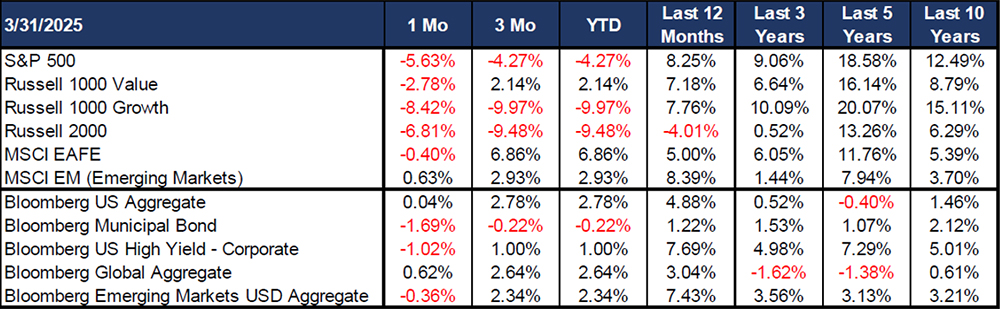
The first quarter saw a modest decline in US equities, with International stocks generating solid returns. We have long preached asset class diversification, and 1Q25 showed how expanding one’s investment universe beyond domestic large cap stocks can prove beneficial. The newfound willingness of European authorities to reindustrialize and militarize appears to be a secular shift that should benefit diversified portfolios for more than a single calendar quarter. With a weakening dollar and many idiosyncratic growth stories, emerging markets remain a target-rich environment as well, for investors who can access high quality active managers.
Bonds generated reasonable returns in 1Q, as the US 10-year Treasury moved from 4.58% to 4.24%, more than offsetting a modest widening in corporate credit spreads.
Swans, Trade Wars, and Wealth Effects
The Roman satirical poet Juvenal is credited with the first written mention of a “black swan,” writing in the 2nd century AD: “a good wife is a bird as rare upon the earth as a black swan.” Casual misogyny aside, the humor/insight of the phrase was based on the assumption that all swans are white. The phrase was common in 16th century England, similar to how we might today use a phrase like “when pigs fly” or “when hell freezes over,” as a statement of impossibility. However, in 1697, Dutch explorers became the first Europeans to see black swans, in Western Australia. What was once deemed obviously impossible was, in fact, very real.
The author/mathematician/trader Nassim Taleb1 popularized the metaphor of “the black swan” in his several books, using it to describe events that share three attributes:
- The event is an outlier, or a surprise, in that it “lies outside the realm of regular expectations, because nothing in the past can convincingly point to its possibility.”
- It carries extreme “impact.”
- In spite of its outlier status, human nature makes us concoct explanations for its occurrence after the fact, making it explainable and predictable.
1The Black Swan: Chapter 1. The Impact of the Highly Improbable, Nassim Nicholas Taleb (2007)
In markets, “Black Swan” has come to mean an impossible-to-predict event that roils markets, like the 1987 Black Monday crash. The policy and market chaos that erupted following April 2’s “Liberation Day” perhaps does not qualify on all three of these criteria. In many respects, President Trump seems to be doing exactly what he campaigned on: engaging aggressively with China to reshape global trade to favor US manufacturing. Call it an Orange Swan.
What was not anticipated by markets (or us) was the scope, scale, and speed of tariff policy. So-called “reciprocal” tariffs, which appear to have been calculated simply using a given country’s existing trade deficit with the United States, were far higher than expected. Moreover, the calculation methodology implies that the end-goal is to shrink the US trade deficit to zero, as opposed to a negotiating tactic to force a “level playing field” in terms of free trade.
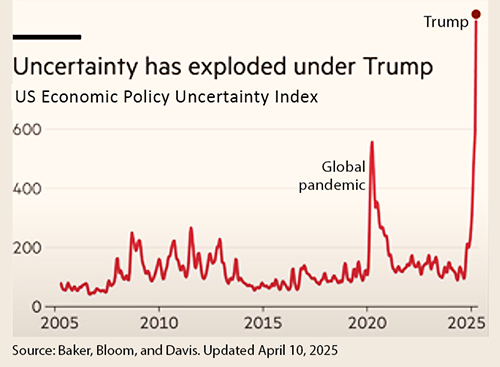
Tariffs are ostensibly a consumption tax partly borne by foreigners. At 10% across-the-board, tariffs could be seen as a reasonable tool to pay for the substantial tax cuts that the Administration wants. In addition to extending the tax cuts from the first Trump Administration, current proposals include a number of policies focused on middle class tax relief and incentives for companies to invest domestically: eliminating tax on Social Security payments, overtime wages, and tips; making auto loan interest tax-deductible (like mortgage interest), lowering the corporate tax rate for domestic production, and a number of other individual tax relief items (including potential changes to the estate tax).
So, the $600B that the Administration claims can be generated by tariffs (we are skeptical of this number) along with the claimed $150B in DOGE savings (again, we would take the under) could pay for these tax cuts. Deregulation would improve productivity, creating a pro-growth cocktail of domestic policy.
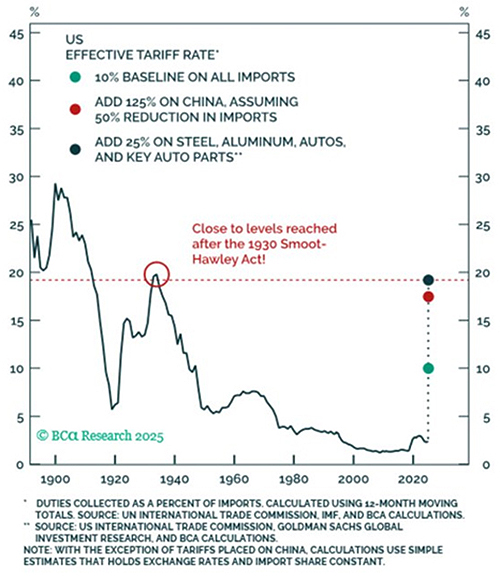
But, at current levels (even absent the reciprocal tariffs that are now set to go into effect July 9), we believe tariffs will prove far too restrictive to growth and risk an escalating trade war that materially impacts global trade and lowers global wealth. Even without the “reciprocal” tariffs, current tariff levels are the highest since the Smoot-Hawley tariffs of Great Depression infamy. Bueller? Bueller? Anyone?
Since “Liberation Day,” US stocks have gyrated wildly between around 5500 and 4800 on the S&P 500. To reclaim the technically important 5700 level and continue the bull market, the duration of reciprocal tariffs needs to be short, and the Administration needs to decisively pivot to tax reform and deregulation. Otherwise, we will likely get a recession, and a bear market.
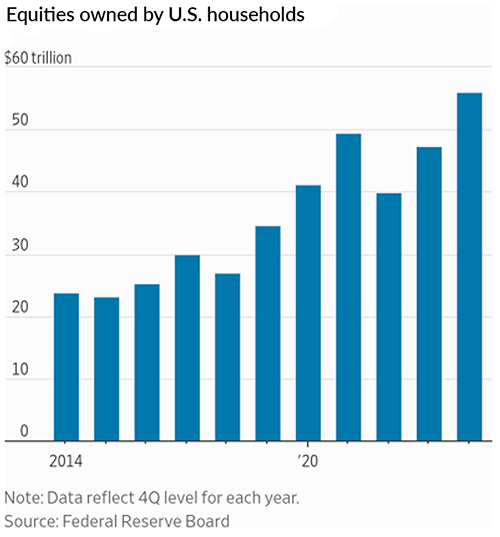
The wealth effect from the stock market sell-off has been large and magnified by two factors. One, households own more stocks, as a percentage of their wealth, than at almost any time in history. As a result, a 10% sell-off in the S&P 500 wipes out household wealth equal to about 12% of GDP.
Additionally, bonds, historically a safe haven asset during stock market volatility, have also sold off. We have heard many conspiracy theories to explain this, but it seems a combination of factors, some fundamental (higher tariffs means higher inflation, at least for a time) and some technical (Google “basis trade” if you would like a very wonky explanation). Certainly, some foreign investors have been selling US assets, contributing to weakness in the dollar against the euro, yen, and Canadian dollar.
For what it’s worth, the idea that China is dumping Treasuries to hurt the US is one we do not buy into (yet). China owns only 2% of outstanding US debt. And if they were selling enough to pressure the bond market, their currency would be strengthening against the USD. The opposite has been happening. We have also heard some breathless talk that US markets are somehow morphing into an emerging market. The dollar, Treasuries, and US stocks rarely sell off at the same time, but they have thus far in April. This is common in emerging markets (or Liz Truss’ UK) when markets lose confidence in economic leadership. But there are only four other episodes in the past 30 years in which the Dollar Index depreciated by more than 1.5% with the 30-year yield simultaneously rising more than 0.10%. We believe this reflects a rational incremental aversion to US assets from global investors in the wake of isolationist policies, not a gestalt shift in US markets. Yes, we like international assets (particularly stocks) as part of a diversified portfolio. And yes, US stocks are likely over-owned globally, and we anticipate increasing (not reducing) our exposure to international assets over time. But the world still operates on a dollar/Treasury system, and that isn’t changing any time soon.
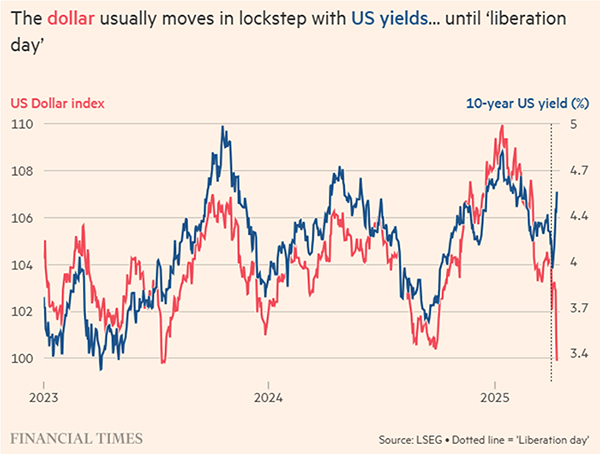
All that is to say, the wealth effect of the market sell-off described herein brings risk to the real economy. A slowdown in consumer spending, along with cuts in government spending, on top of tightening credit conditions and a Fed on hold, is not a great combination for economic activity or asset prices. Additionally, we need to see US Treasury bonds begin to act more “normal” to believe in a sustainable stock market rebound. There is little argument for higher risk asset prices if 10-year Treasury yields are moving to 5%
That said, many investors have capitulated, stocks are oversold, and at reasonable valuations if a trade war is short and corporate earnings hold up. If we knew it would be short, stocks represent excellent value. If we knew it would last four years, stocks are unattractive and bonds are the only place to be.
So, how to handicap this? Anyone who says with confidence that they know where this goes is speculating. I’ve been in capital markets for 25+ years, and lived/invested through two others that were recessions in all but name (2022, plus the 2015/16 shale crash/China slowdown/industrial recession) and many more bear markets. I can say that this is the least obvious market set-up in that time period. Simply put, we (and I mean everyone, not just the team at SYB) haven't seen this before. If you’re not at least a bit confused, and not open to multiple potential outcomes from here, you are not paying attention. The current environment reminds us of a quote from Kentucky’s own Wendell Berry: “the mind that is not baffled is not employed.”
So, how to position portfolios in this context? Financial historian Peter Bernstein wrote “diversification is the only rational deployment of our ignorance.” The solution to the Orange Swan risk is the same as the Black Swan risk: Balanced global portfolios across asset classes, and thoughtful tactical shifts to take advantage of changes to risk premia.
Don’t Just Do Something, Stand There!
In times of uncertainty, if an investor has a properly constructed portfolio, the best answer is often to do nothing. Reflecting our view toward substantial two-way risk across most narratives and asset classes, we are biased toward neutral positioning across most risk allocation benchmarks.
But as another of our favorite market analysts likes to say: “shifts in growth, inflation, risk premium, and positioning all lead to opportunities in markets.” Within equities, we are a Quality Growth shop. Companies with above-market revenue growth, purchased at reasonable valuations, tend to outperform. But we have been spending more time focusing on the valuation of stocks we own (especially through the lens of a potential recession) and continue to make an ongoing shift toward businesses that benefit from deglobalization and a weaker dollar. These include US safe haven sectors like healthcare and utilities, but also selected foreign stocks (in both Europe and Emerging Markets ex China). For long-term investors, we are starting to see super high-quality companies trading at legitimately cheap valuations for the first time in three years.
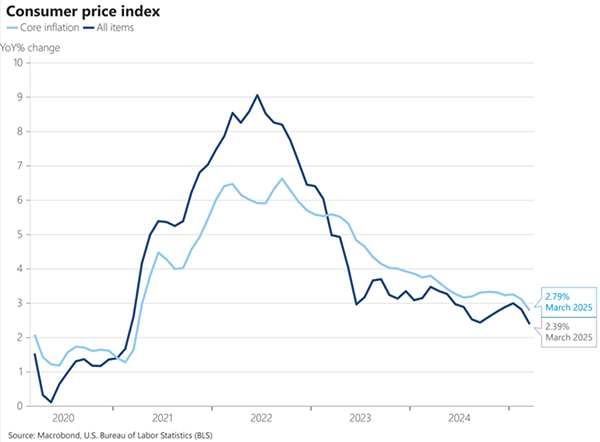
In fixed income, we continue to favor a barbell of shorter-dated investment grade corporates and longer-dated municipal bonds (for taxable investors). We have also been adding exposure to alternative investment strategies within fixed income (more on this later). The odd weakness in Treasuries, along with some progress on inflation, has created a reasonable opportunity to modestly extend duration in fixed income portfolios. For income investors, this is another opportunity.
Playbooks
Rather than spend more time and ink (pixels?) on tariffs and trade wars and Trump, of which you can get your fill from pretty much any news outlet, we thought we’d spend the rest of this outlook discussing some tactical opportunities we see and holdings where we are especially convicted.
The first is within the fixed income complex, and falls broadly into the category of “alternatives,” specifically hedged credit. In the context of heightened market volatility, economic uncertainty, and risk-off sentiment, we maintain a tactical allocation to a differentiated strategy in lieu of traditional High Yield (HY) bonds due to its defensive structure, diversified income streams, and active risk management approach. Our solution presents a market-neutral profile, lower correlation to credit markets, and ability to deliver asymmetric risk-adjusted returns during periods of dislocation and historically tight credit risk premia.
In an environment of macro uncertainty, elevated equity volatility, and widening credit spreads, we view our selected HY proxy instrument as a superior alternative to high yield bond funds. Its characteristics offer a more defensive, uncorrelated source of return that aligns with capital preservation objectives, while still participating in volatility-driven upside. This positioning supports stronger risk-adjusted performance and portfolio resilience in periods of market weakness.
This strategy has proven to mollify downturns when HY spreads widen and will outperform HY in these events. It also generates consistent performance as rates move around so no outcome of rates giving and taking away total return. With a 1+ Sharpe Ratio (i.e. expected return greater than annualized volatility), the effect of lowering volatility and increasing return when blended with other yield strategies, and a semi-annual distribution nearing 4%, this fixed income alternative is an attractive place to “hide out” in the current environment.
Within our equity portfolios, we focus on Quality Growth companies. But we aren’t dogmatic and view the “value” versus “growth” construct as a false alternative. Except for those who systematically chase price momentum, all investors are “value” investors, just the definition of what constitutes good value varies. Peter Thiel, in his book “Zero to One” talks about wanting to own businesses that are effective monopolies and, while perhaps hated, are too integral to the system to face existential regulatory headwinds. Alphabet (GOOGL/GOOG) is the business he cites as an example of this (how would one even go about “breaking up” Google, and to what consumer gain?), but the credit card companies (Visa (V) and Mastercard (MA)) are another example. UnitedHealth (UNH) is yet another. UNH would be labeled a “value” stock by most. But it’s also the exceptionally rare mega-cap growth story that’s US-only, creating a degree of revenue resiliency difficult to find. We like businesses that operate in oligopolies (e.g. cloud computing) and benefit from regulatory capture (e.g. Philip Morris (PM)). Check and check. We like businesses with clear line-of-sight into steady multi-year free cash flow growth (e.g. META). With the clear demographic tailwind of Baby Boomer aging and healthcare spend, this is also the case with UNH. We think this company can earn $45-50/share three years in the future. At a price of around $450/share, we see no reason this stock can’t return 15-20%/year over the next 3-5 years, and expect the company to be able to grow revenues through an economic downturn. We believe the recent earnings-related sell-off in the stock was an overreaction, creating opportunity for investors.
Healthcare (along with utilities, telecom, and consumer staples) is a sector that has provided a port in the storm of recent market turmoil, and with good reason. Tech, on the other hand, has not been. The Mag7 led the way up in the bull market of 2023-24, and have led the way lower YTD in 2025. However, this doesn’t mean there aren’t high growth technology companies capable of growing through a recession. Palo Alto Networks (PANW) is the industry leader in cybersecurity, providing mission critical software that is the last line item any corporate Chief Technology Officer is going to recommend cutting. PANW’s addressable market is of growing structural and secular importance. The business represents a tech/growth story disconnected from physical goods trade, and thus insulated from tariffs, unlike, say, Apple. To the extent hardware (i.e. semiconductors) has outpaced software over the past few years, we expect some reversion to the mean and therefore are biased to like software companies as a contrarian play. Returns on invested capital are increasing for PANW (nearly 70% last year) and margins are expanding, driving substantial free cash flow growth/visibility. If PANW can continue to grow free cash flow as we expect over the next year, and simply maintains its historical free cash flow yield, the stock is worth closer to $225 versus $170 today.
While UNH and PANW have been long-term holdings in SYB client portfolios, to which we have added lately, Emcor (EME) is a more recent addition, purchased in late 2023. Our approach is to find high quality businesses with growing cash flows, ideally with tailwinds from a secular growth theme. EME is positioned to benefit from two distinct-but-related secular themes: infrastructure investment and artificial intelligence. A leading electrical and mechanical construction firm, EME is one of the largest specialty construction and facilities services firms in the US. While the stock began to move with other AI beneficiaries in 2024, EME actually has a diversified business model and isn’t just for data centers, offering mechanical, HVAC, energy infrastructure, and facilities services across multiple industries. Revenue growth has been steady and margins have steadily expanded from under 4% to close to 10% over the past decade. With this, returns on invested capital have grown from under 10% to over 30%, a trend we expect to continue. Future growth drivers for the business include energy efficiency and green building trends, government infrastructure spend, strategic M&A (acquiring smaller competitors to expand market share), and technology and automation (yes, datacenters, but also smart building solutions, predictive maintenance, and AI-driven facility management). In terms of financial strength the company has a strong balance sheet with very low liabilities (what appears as “long-term debt” on the balance sheet is lease liabilities, not bonds). Aside from a brief pullback last Summer, the stock has not provided a ton of great entry points since, but we believe the recent weakness affords a decent buying opportunity. The stock trades at 16x forward earnings (cheaper than the market as a whole). If infrastructure and datacenter spend continue on anything like the current trajectory, this company can earn $25-30 in three years versus a stock price of under $390.
Conclusion
We wrote in our 2025 outlook “while animal spirits and optimism are high presently, a turning of the tide in business sentiment could underwrite a larger correction in 1H25.” This is obviously playing out at present, and the question is whether that correction is complete. “Soft” economic data like consumer surveys are terrible. But “hard” economic data like consumer spending and the labor market remain solid. While uncertainty and macro volatility look set to remain high in 2Q, we are seeing a variety of opportunities, be it in the Quality Growth or Defensive Value companies discussed above, the alternatives strategies we utilize to diversify portfolios, or a bond market that is not priced for the slowing growth we see evidenced in the soft economic data. We also wrote last quarter “flexibility and open-mindedness are what makes for winning investing and suspect this will be more true than usual in 2025.”
We hope you’re enjoying the run-up to Kentucky Derby 151. Please reach out to us any time with questions.
We provide the information in this newsletter for general guidance only. It does not constitute the provision of legal advice, tax advice, accounting services, investment advice, or professional consulting of any kind. The information provided herein should not be used as a substitute for consultation with professional tax, accounting, investment, legal, or other competent advisers. Before making any decision or taking any action, you should consult a professional adviser who has been provided with all pertinent facts relevant to your particular situation. The information is provided “as is,” with no assurance or guarantee of completeness, accuracy, or timeliness of the information, and without warranty of any kind, expressed or implied, including but not limited to warranties of performance, merchantability, and fitness for a particular purpose.
Investment and Insurance Products are:
Not Bank Guaranteed | Not a Deposit | May Lose Value
Not FDIC Insured | Not Insured By Any Federal Government Agency