


Market Outlook Q4 2023: The Revenge of the Bonds
Mon, 11/06/2023 - 17:03 Wealth management

Chief Investment Officer
(502) 259-2543
John.Fidler@syb.com
“Interest rates are the traffic signals of a market economy.” –James Grant
“The most important item over time in valuation is obviously interest rates. Any investment is worth all the cash you’re going to get out between now and judgment day, discounted back.” –Warren Buffett
“I used to think that if there was reincarnation, I wanted to come back as the President or the Pope or as a .400 baseball hitter. But now I would like to come back as the bond market. You can intimidate everybody.” –James Carville
Batman of the Bond Markets
Batman may be the most famous movie vigilante, but over the years the bond market has had its own unofficial enforcement arm. So-called “bond vigilantes” are investors who protest against inflationary policies by selling bonds, thus increasing yields. In 1993/1994, as the newly-elected Clinton Administration grappled with the budget deficit, the Alan Greenspan-led Federal Reserve hiked short-term interest rates from 3% to 6%. At the same time, US 10-year bond yields rose from 5.2% to just over 8%, fueled by concerns about federal spending, in what informally became known as “the Great Bond Massacre.” Carville, then a political adviser to President Clinton, and others, in part, blamed “the bond vigilantes” for this dramatic increase in interest rates.
Third Quarter Review
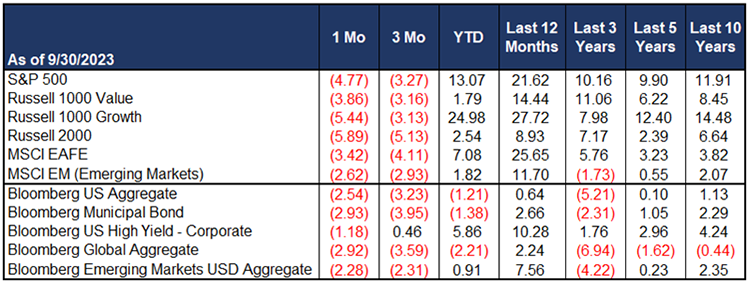
Fast forward to the 3rd quarter of 2023 where asset prices fell broadly, with the S&P 500 declining 3.3%. Global equity and bond markets (with the exception of US High Yield Corporates) were down similarly. These moves were in large part driven by an increase in long-term interest rates. The 10-year Treasury yield rose from 3.8% to 4.6% and has since continued rising, with a recent peak above 4.8% in early October. This recent surge in yields hardly rises to the level of magnitude that Carville described in the mid-90s, but the past few months have become reminiscent of this kind of investor revolt.
The Chairman’s War on Inflation
For most of this year, Fed Chair Powell has emphasized his commitment to reducing inflation towards the Fed’s 2% long-term target. We have long taken the Fed at their word on this point. Despite unintended consequences, like the bank panic back in March, we expect rates to remain “higher for longer.” As we wrote this Spring: “We remain skeptical that the Silicon Valley Bank collapse will derail the Fed’s rate hike cycle in a meaningful way.” Exactly what level the Fed stops hiking short-term interest rates (the so-called “terminal rate”) is less important, in our view, than the fact that rates will remain relatively high and financial conditions will remain relatively restrictive. This is especially true considering the zero or near-zero interest rate policies that have ruled for most of the 15 or so years since the Global Financial Crisis (GFC).
A Change in the Traffic Signals
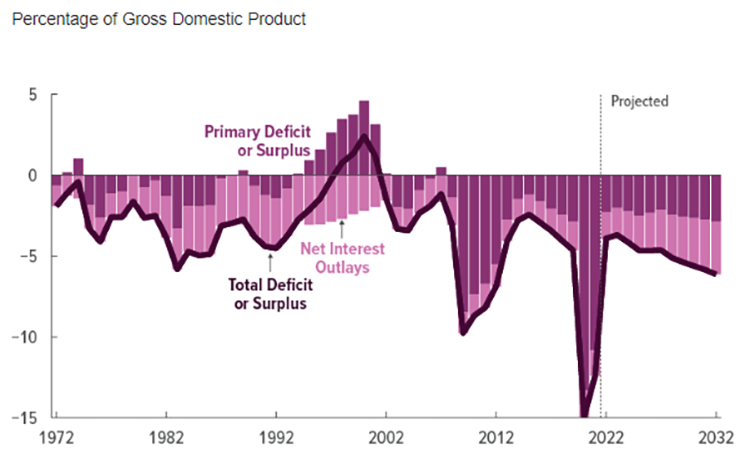
Since stock prices peaked in July, not only have the markets begun to take the Fed’s “higher for longer” promises seriously, but market fundamentals have changed as well. The US Treasury announced in August, for the first time since COVID, quarterly bond sales would be boosted because of an unexpected widening in the US budget deficit. This increase is on top of the $1 trillion in new Treasury bonds that were already expected. At 8% of GDP, the deficit is large, especially in the context of a growing peacetime economy. At the current run-rate, the 2023 interest expense will be greater than any other line item in the Federal budget, except for Social Security (bigger than Defense spending or Medicare).
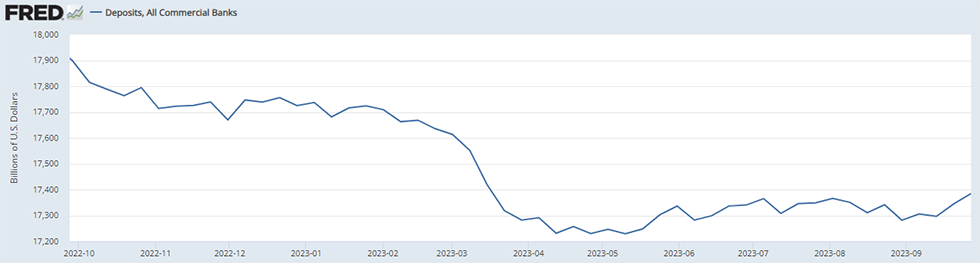
In the words of Greg Jensen, the CIO of the world’s largest hedge fund, Bridgewater Associates, “They’ve got a lot of catch-up bond issuance to do.” To Jensen’s point, the Treasury issued a lot of short-term bills earlier this year to fund the deficit. With T-bill yields well in excess of what investors could earn on bank deposits, those bills were eagerly absorbed by the market. The preference for higher yields contributed to deposit flight (shown below) that in turn led to events like the failure of Silicon Valley Bank.
The Fed Shifts from Buyer to Seller
But now, with the Treasury shifting back towards longer-term bond issuance, significant bond supply has hit the market. And while we’re not ready to call them bond vigilantes yet, investors are demanding higher returns to take longer-term risks.
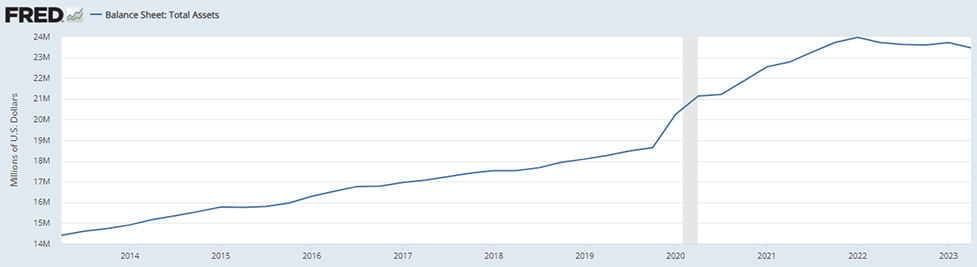
This supply/demand dynamic is further exacerbated by monetary policy. In addition to raising interest rates, the Fed is also allowing the bonds they own – specifically, the bonds they bought during COVID to inject liquidity into the economy – to mature. The fancy economics term for this balance sheet shrinkage is “quantitative tightening” (QT), the opposite process of the quantitative easing (QE) that occurred repeatedly following the GFC, and again in earnest in 2020/21. While the tick down in the size of the Fed’s balance sheet shown below may look trivial (total assets are still around $23 trillion), it’s important to remember that this is really the first time since 2009 that their bond holdings have done anything but grow.
The Fed and Congress Dancing to Different Tunes
In short, the US Congress is running a massive fiscal deficit that almost requires QE to sustain itself; but the Federal Reserve is running a monetary policy (combat inflation) that requires QT. These dynamics are at odds with one another and it remains to be seen how they will resolve. Will the Fed return to QE when an economic downturn inevitably occurs at some point? Will Washington take steps to get its fiscal house in order, as the Clinton administration and the Newt Gingrich Congress ultimately did in the 1990s? 1998 was the last year the US had a budget surplus and this bipartisan fiscal restraint was a major factor in reducing inflation from 6% to 3%.
Where Do We Go From Here?
So, where does this leave us in terms of the path forward for the economy? And how should investment portfolios be positioned as a result? Our base case remains that this cycle plays out in line with historical precedent. That would imply monetary tightening leads to earnings contraction, companies lay off workers to cut costs, unemployment rises, and a garden variety recession ensues; somewhere between a hard landing and a soft one, but nowhere near as painful as the “crash landings” of 2008 and 2020. Creative destruction, not central planning to avoid every downturn and protect every bad investment, is what makes capitalism work.
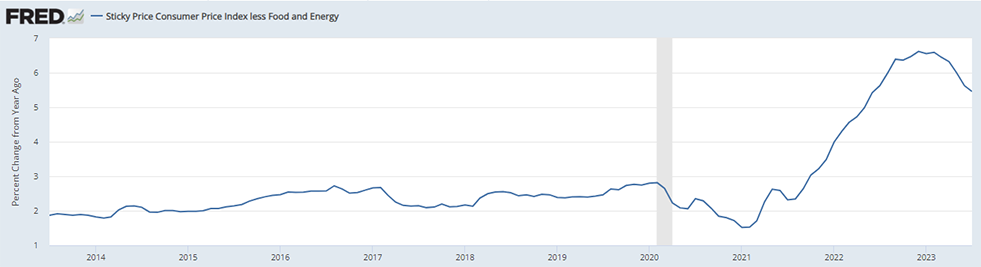
The answer to the first question is simple in theory: Rates go up, financial conditions tighten, inflation and growth come down. In reality, the process has been protracted and bumpy, because monetary policy impacts the economy with long and variable lags. We have been in a “higher for longer” interest rate world for all of this year, and expect to remain there well into 2024. While raising short-term rates has brought the inflation rate down, the Fed has not fully achieved its goal, as core inflation remains about double the long-term target.
The Most Important Item Over Time in Valuation
In recent months, long-term rates have risen to new highs, in part because the supply catalyst described previously has narrowed the spread between short-term and long-term rates. This process is known as yield curve steepening. As a result, the equity market has declined from recent highs as earnings multiples have compressed.
Many investors look at a 10-year Treasury yielding close to 5%, compare it with a stock market where the “earnings yield” (trailing 12-month S&P 500 corporate earnings divided by the current price) is closer to 4.5%, and decide that bonds (or cash, yielding north of 5%) is the better relative value. The “traffic signal” described by James Grant may not be flashing red for equities, but is certainly yellow, at least for large parts of the market.
Currently, the stock market declines we have seen since July are fairly trivial, but if they were to continue, the tightening effect from higher bond yields and ongoing multiple compression would eventually lead to a contraction in corporate earnings.
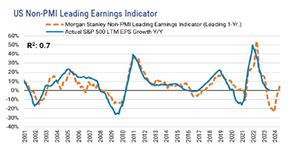
Ironically, this has already happened in large part. The US stock market has been in an “earnings recession” (negative year-on-year earnings growth) since 4Q22. Consensus expectations for the 3rd quarter are for flat earnings growth, rising to 9% growth in the 4th quarter, and 12% growth in both 2024 and 2025. We have been skeptical of this consensus for much of the year, given the weakness in many leading economic indicators that usually predict forward earnings. However, as the economy has remained resilient in 2023, these indicators have turned higher, and there is certainly a chance the economy will sail through this period without a substantial downturn. As a colleague recently observed, “Maybe we already had the recession in 2022.”
The Economy at Present
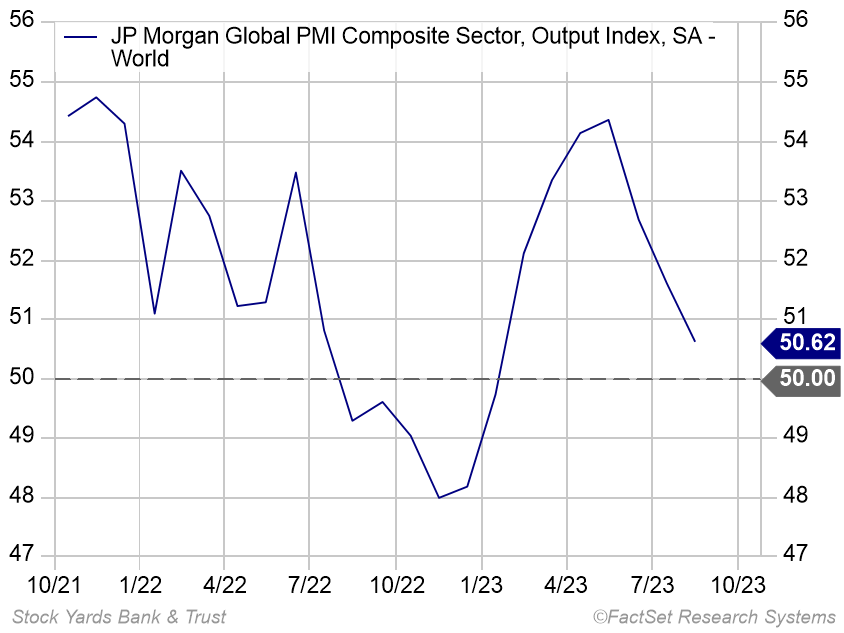
Admittedly, there are few economic indicators currently pointing to imminent recession. The economy remains resilient and measures of global economic activity remain in positive territory. And, thanks to persistent wage gains over the past three years, consumers still have some “excess savings” from COVID-era stimulus.
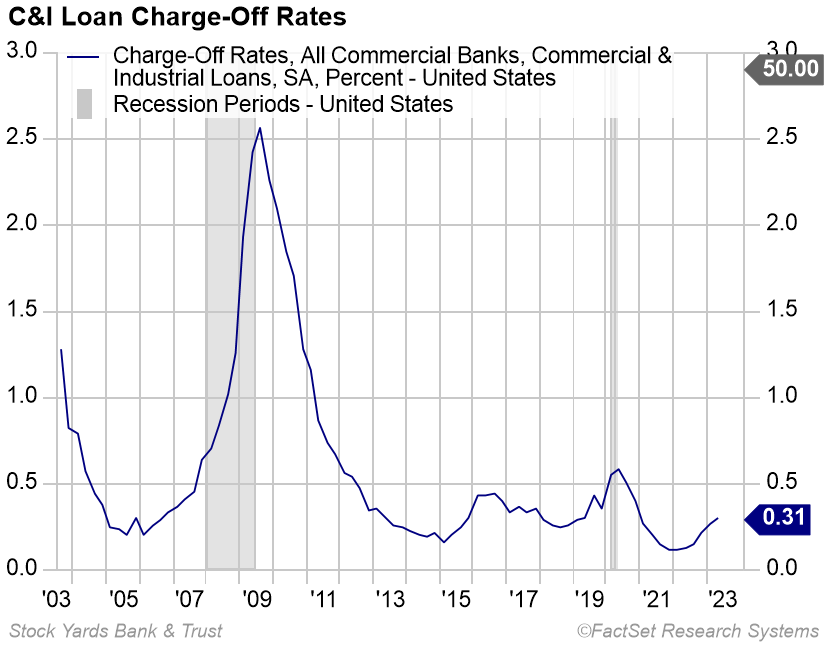
The banking system remains healthier than advertised. Reserve levels remain high relative to history, despite the deposit flight discussed earlier. And credit quality, while trending slightly worse, is still at better absolute levels than most of the past decade.
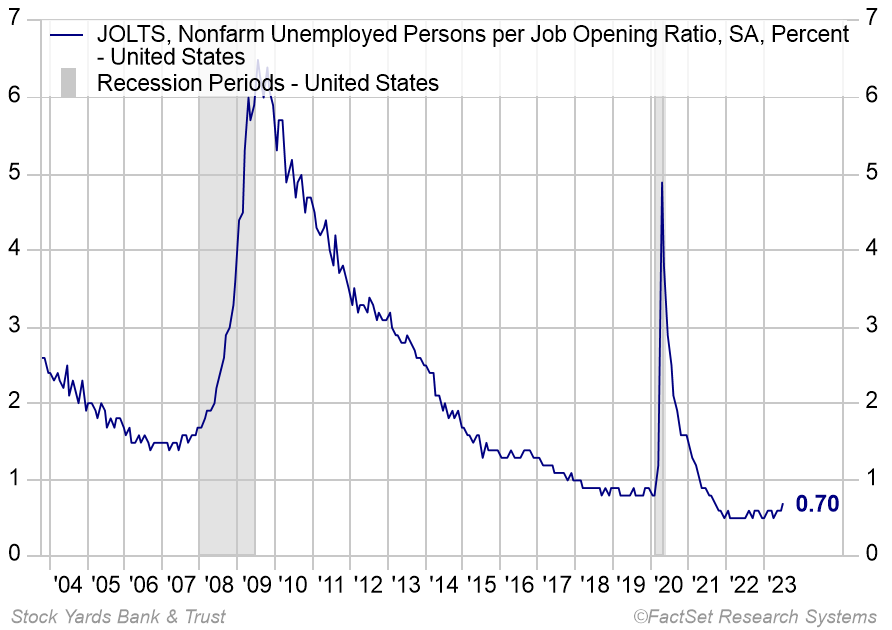
The labor market is strong, with plentiful jobs relative to the number of unemployed.
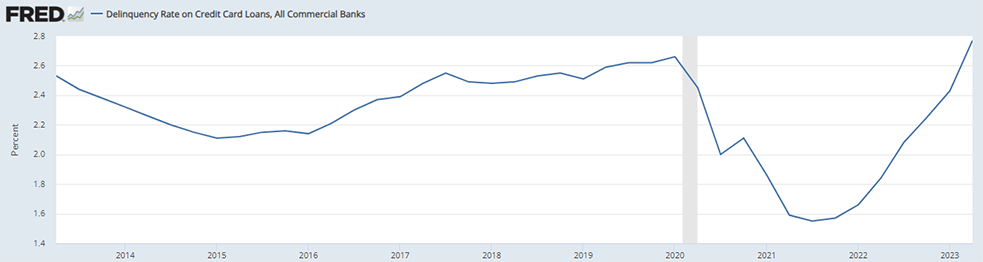
However, those savings are being steadily drawn down and credit card delinquencies are rising.
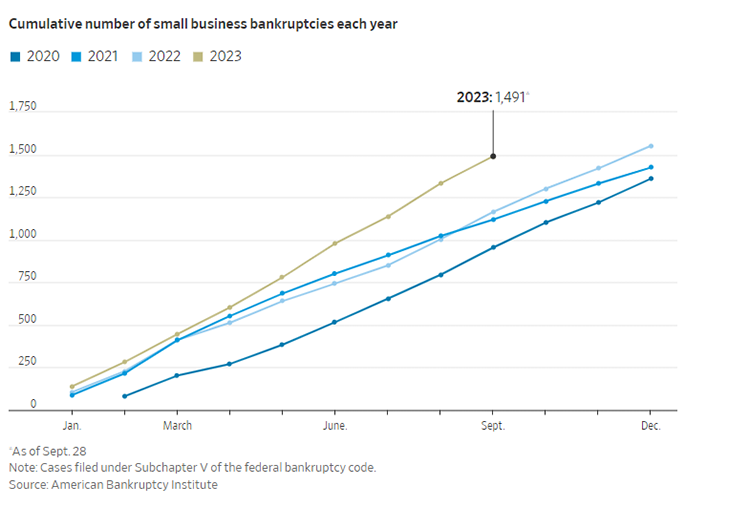
The same story is visible in the corporate sector, where the trend in small business bankruptcies is rising relative to the prior 3 years (though still close to 30% below pre-COVID levels).
Given these cross-currents, how are we positioning client portfolios? As we wrote last quarter, “Our view is still that the potential for a forward liquidity crunch is being underpriced by the markets.” These risks are now better priced in bond markets, given the rise in yields, but less so in stocks, generally speaking.
Asset Class Outlooks
- EQUITIES: As Warren Buffett noted above, interest rates matter in stock valuations. One could argue, on this basis, that the broad market is more expensive now than it was at the July highs. However, pockets of value exist. The benefit of taking a long-term view and focusing on quality growth companies is that our portfolios are concentrated in businesses that have the competitive advantages, market positioning, and pricing power to grow through a normal economic downturn. This includes defensive companies to be sure, like high-quality consumer staples aligned with demographic trends and sporting hefty/safe dividends, or innovative utilities leveraged to the secular trend of renewable energy. It also includes sectors that tend to perform well late in the economic cycle, where high-quality businesses capable of generating massive free cash flows are underappreciated (e.g. oil & gas). But even within higher growth sectors like tech, there are good long-term opportunities. An example would be cybersecurity, the last line item on any corporate IT budget a CFO is going to cut.
- FIXED INCOME: With the move higher in rates this quarter, bond investors have the ability to lock in 5-6% nominal yields for the next 5-10 years (or more). With inflation slowly but steadily falling and long-term inflation expectations around 2.5-3%, a 2% real yield appears compelling. We have been shifting exposure from cash or short-dated fixed income to longer-term bonds in portfolios (extending duration). Bonds are beginning to present compelling value and provide a valuable deflation hedge.
- INFLATION PROTECTION: If calls for a “soft landing” are correct, the equities portion of portfolios will continue to perform. If we get a “hard landing,” rates should fall and bonds perform well. But a worst-case scenario for most investors is stagflation, a recession coinciding with persistent inflation. In this scenario, we would likely see market behavior similar to 2022, when stocks and bonds fell together. Inflation protection can be provided from natural resource companies (like energy, a sector that rose over 60% in 2022) and diversifying alternative investments, where appropriate.
- CASH: As discussed, cash is a less relatively attractive option than it was a quarter ago, given the rise in long-term rates. But with money market yields still north of 5.2% (and likely to rise closer to 5.5% before year-end), it remains reasonable to be overweight in one’s long-term target cash allocation.
In short, our outlook and recommendations remain consistent with the past few quarters. With a slowing economy, stubborn inflation, high-interest rates, and increasing uncertainty, this remains a time to build “all-weather” portfolios that are diversified at the asset class level and provide optionality to take advantage, through rebalancing, of future market volatility.
We provide the information in this newsletter for general guidance only. It does not constitute the provision of legal advice, tax advice, accounting services, investment advice, or professional consulting of any kind. The information provided herein should not be used as a substitute for consultation with professional tax, accounting, investment, legal, or other competent advisers. Before making any decision or taking any action, you should consult a professional adviser who has been provided with all pertinent facts relevant to your particular situation. The information is provided “as is,” with no assurance or guarantee of completeness, accuracy, or timeliness of the information, and without warranty of any kind, expressed or implied, including but not limited to warranties of performance, merchantability, and fitness for a particular purpose.