


Market Outlook Q4 2024: Over Easy
Wed, 10/30/2024 - 14:51 Wealth management

John M. Fidler | Chief Investment Officer
(502) 259-2543 | John.Fidler@syb.com
Q3 Review
Despite recession worries this Summer over a cooling labor market, the economy remains resilient (feels like we’ve been writing that phrase all year) and markets continued to move higher in the 3rd quarter.
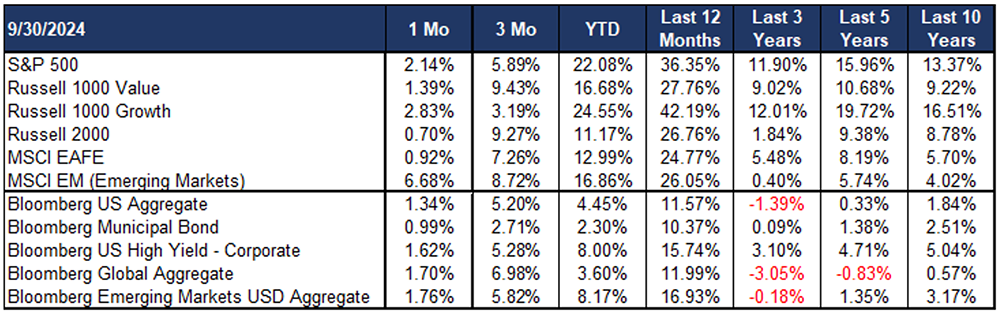
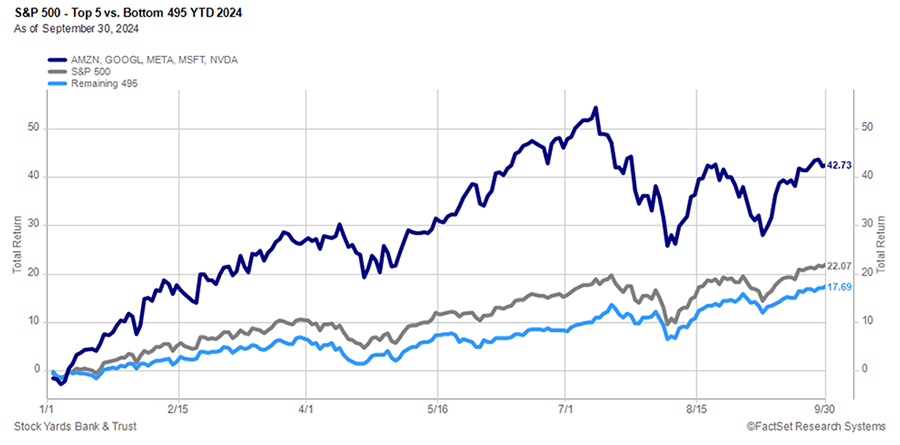
Encouragingly for diversified investors, 3Q was a “breadth” of fresh air, as one of our investment team members termed it. The dominance of the Magnificent 7/Fab 5 waned a bit in 3Q and we saw much broader market participation, with small caps, international, value, and emerging markets all outperforming the S&P 500’s gain of nearly 6% on the quarter. Through June, the top five stocks in the S&P 500 had outperformed the index by 31% and the bottom 495 stocks by 38% YTD. As of September 30, those gaps had narrowed to 21% and 25%, respectively. We’ve discussed the relative value of small caps and emerging market stocks in prior outlooks, and despite the recent outperformance, these asset classes still seem target-rich environments. Diversification remains the only free lunch in finance.
Regime Shift
Over the summer, inflation data cooled, and we began to see a concerned downtrend in job creation (and an uptick in unemployment rate). Apart from driving two short-lived stock market corrections, one in early August and one in early September, this development caused a shift in how markets seem to be reacting to economic news. For three+ years, market participants were concerned first and foremost with the high level of inflation. Solid growth was taken as a given, but the fear was over how high the Fed would need to raise rates, and how long rates would need to stay at those levels. “Higher for longer” was shorthand for the Fed needing to keep rates elevated for longer than the markets believed, in order to break the back of inflation.
At the end of 2023, the Fed “pivoted,” declaring that the path to a sustainable 2% inflation rate was clear. Investors cheered this news and over-extrapolated it into markets, rallying equities and pricing in 6-7 2024 rate cuts. Resilient growth and sticky inflation spooked the stock market, which sold off sharply in April. (It may be hard to remember now, but Nvidia sold off over 20% in March and April.) Markets wanted rate cuts, and they knew they needed a cooler economy to get them. As a result, bad news was good news. A slower economy meant cooling inflation, and in turn investors would finally get those much-desired lower interest rates. So, investors actually wanted to see a weakening economy (bad news) in order to push stocks higher (good news).
As they say, be careful what you wish for. In July, it appeared the economy might be slowing a bit too much for comfort, and stocks sold off. This was the moment it appeared that bad news was bad news. The market’s fear suddenly shifted from inflation being too high to growth being too low. As a result, a deluge of Fed interest rate cuts were priced into bond markets, and the Fed gave the market what it wanted: a 0.5% rate cut in September, with the promise of lower rates ahead.
What would a “soft landing” look like?
The overwhelming market consensus is that the US economy, aided by savvy Fed policy, will experience a “soft landing” in which inflation cools to 2%, growth remains strong, and no recession occurs. (And as we know, consensus is never wrong!) We’ve taken issue with this view for most of the year, making the argument that inflation can’t be truly brought to heel without causing some pain in the real economy. The alternative would be for the Fed to accept a structurally higher level of inflation than their 2% target, which has its own risks.
We know that, historically, when the Fed cuts rates, it’s because they see trouble ahead (or the trouble is already here, and they are struggling to catch up). But what does the macroeconomic backdrop look like today? While we cannot rule out a 2025 recession, the reality is that there is precious little to tell us a “hard landing” is on the horizon.
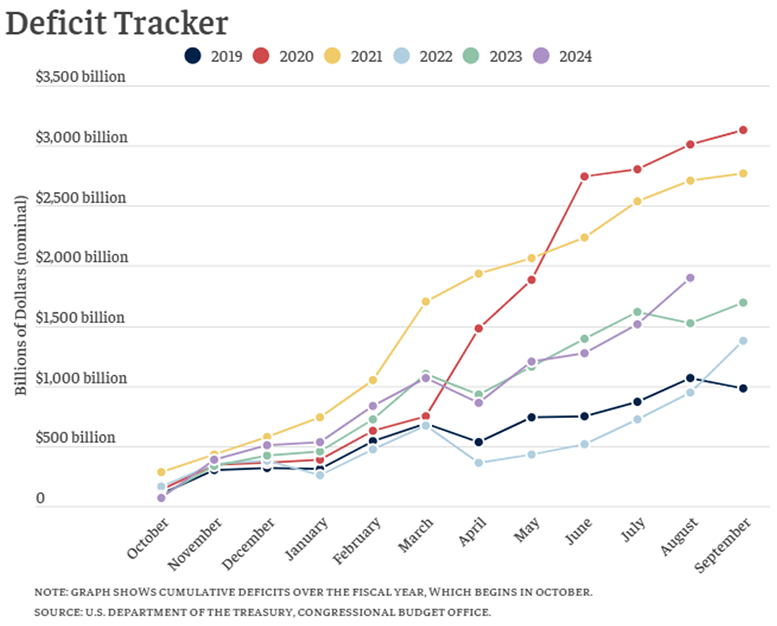
As we approach the Presidential election, we can say with certainty that fiscal austerity will not be what tips the economy into recession. While government outlays are only growing slightly and are a far cry from the “helicopter drop” stimulus of 2020/2021, the government continues to deficit spend, and neither Presidential candidate seems in a hurry to change that.
With housing prices up and stocks near all-time highs, household wealth is growing at steady levels, providing collateral for borrowing and a source for spending, not what is typically seen going into a recession.
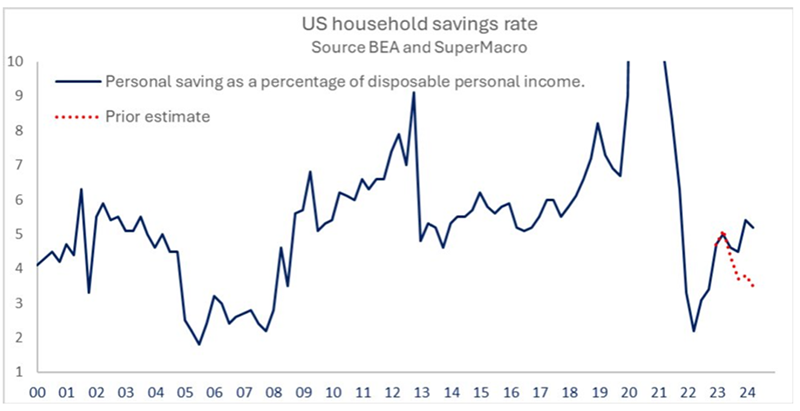
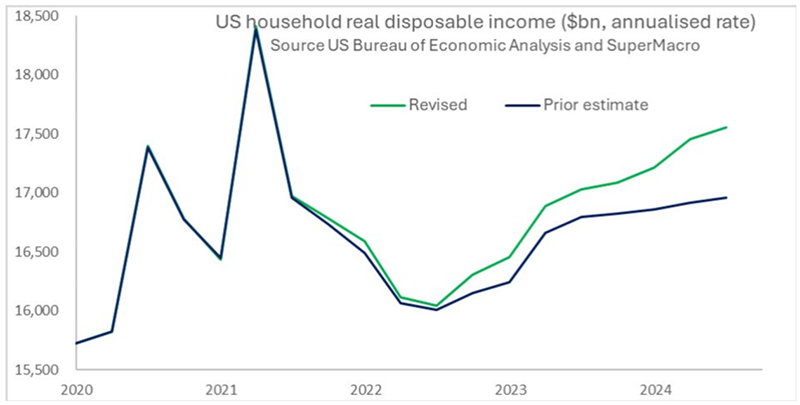
Moreover, in October the US household savings rate and real disposable income were revised higher. So, despite rising credit card and auto delinquency levels, US household balance sheets remain quite healthy in aggregate.
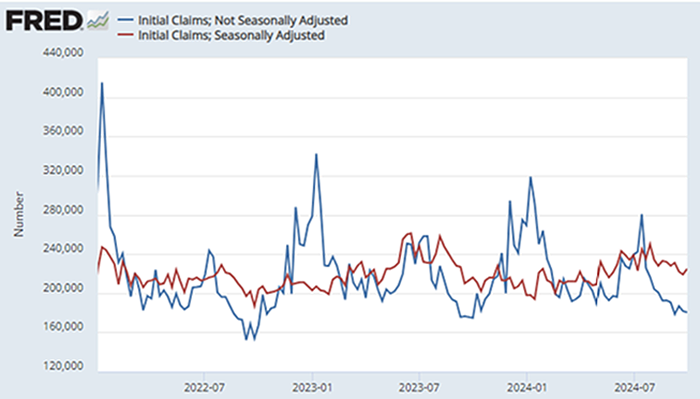
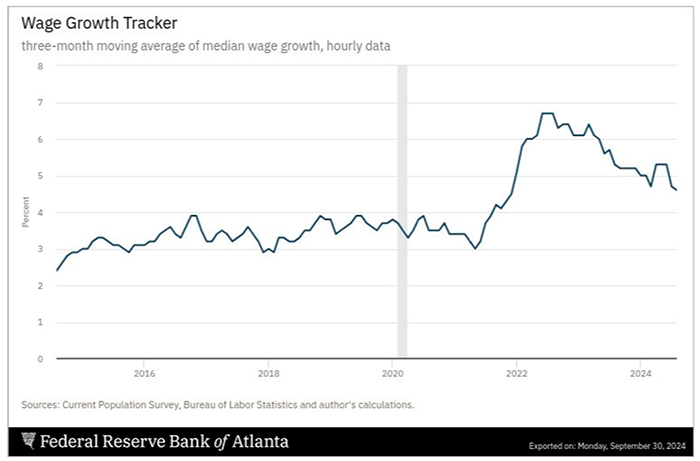
Speaking of data revisions: While the unemployment rate trended higher over the Summer, payroll data improved surprisingly in October and, perhaps more importantly, job creation for prior months was revised higher. This squares with stable levels of new and continuing jobless claims and solid wage growth (which, while below the nosebleed levels of 2022, is well above pre-COVID trends).
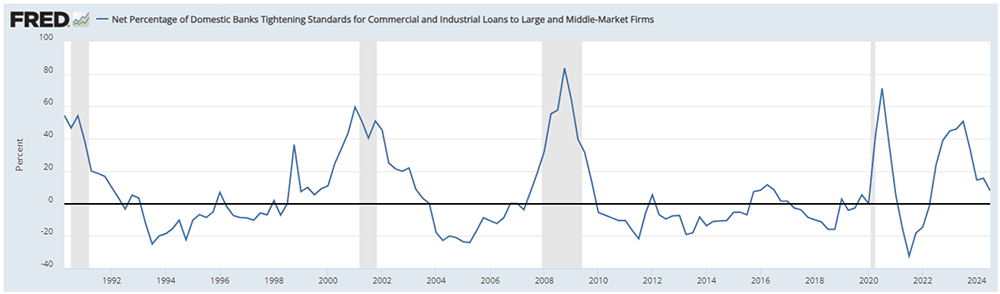
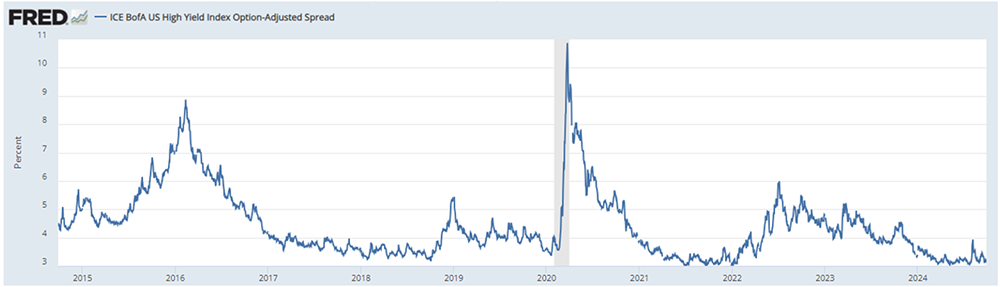
So, households have high levels of wealth, savings, and earnings. And while the labor market has cooled, it’s far from flashing imminent recession signals. The corporate sector appears to be in even better shape. Corporate balance sheets are healthy, and both the availability and cost of credit are not restrictive. Interest rates have fallen sharply over the Summer, banks are not tightening their lending standards, and the cost for high-yield corporates to borrow has seldom been cheaper.
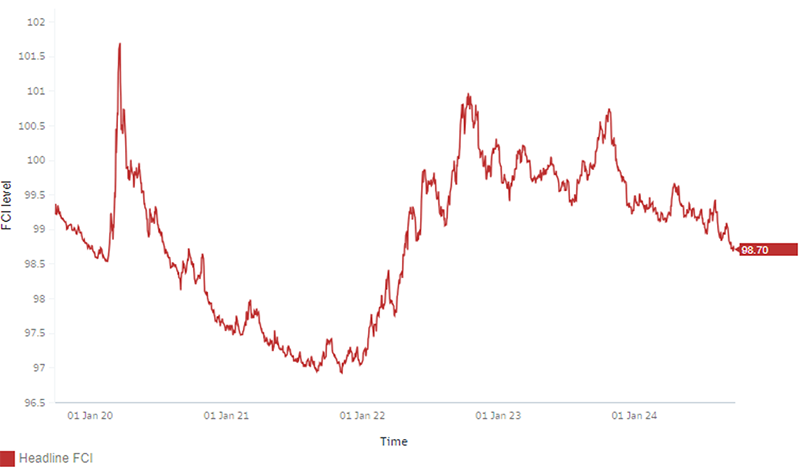
This benign backdrop is reflected in financial conditions, which are the least restrictive in more than two years.
But against that backdrop, the Fed is signaling (and bond markets are pricing) another 200 basis points of rate cuts in the next 12 months. The Fed remains confident that inflation is headed to 2% (or may already be there) and so wants to narrow the gulf between their current 4.75% Fed Funds rate and that 2% inflation level (a.k.a. the “real” interest rate).
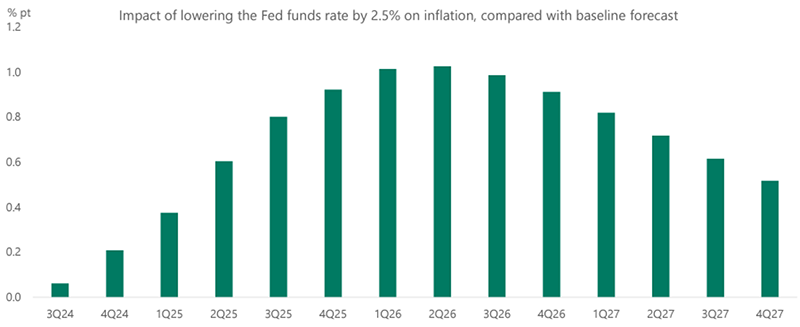
The problem is that this magnitude of easing is likely to put a floor under both growth and inflation, risking a re-acceleration of inflation in 2025. According to work done by asset manager Apollo Global Management, using the Fed’s own economic models, a 200bp cut would boost growth by over 2% and inflation by 1%.
Additionally, the Fed is hardly alone in pushing stimulative monetary policies around the globe. Central Banks in the UK, Europe, and Canada are cutting rates. Japan raised rates this Summer; however, they remain barely above zero. Australia is holding rates steady but has softened its previously hawkish stance. So, the US is hardly alone in pushing “easy money” policies.

All in all, the current macro backdrop is not indicative of further economic slowdown and implies that that policy outlook is “over easy.”

This is good news, in that the economy looks unlikely to fall into recession in the near term. But it’s bad news in that the current “Goldilocks” environment for asset pricing is unlikely to persist if the Fed fails to deliver rate cuts as expected. In that scenario, we would expect bond yields to rise (prices fall) and stocks to correct in sympathy. If the Fed fails to cut rates as expected despite a resilient economy (perhaps to keep debt service costs low for the Treasury), the 1998-style inflationary melt-up we discussed in our last Outlook becomes a strong possibility. This would be nice in the short-run (who doesn’t want stock prices to double in two years, as they did in 1998-2000, other than perma-bear newsletter writers?) but eventually risks the type of boom/bust cycle we saw in 2020-2022.
Signal vs. Noise
Israeli psychologist Daniel Kahneman, who passed away in March, spent much of his career uncovering the cognitive biases that flaw human decision-making. (We recommend his highly-readable 2011 book “Thinking, Fast and Slow” for any audience and his way-more-academic 2000 book “Choices, Values, and Frames” if you’re of the super-nerdy persuasion.) A key component of his work has to do with isolating valuable information (the “signal”) from a sea of unwanted or distracting elements that can interfere with analysis (the “noise”).
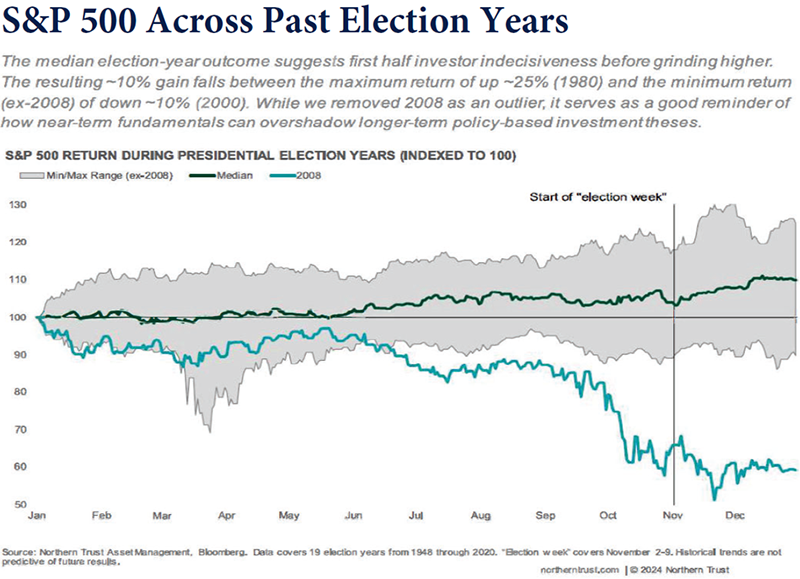
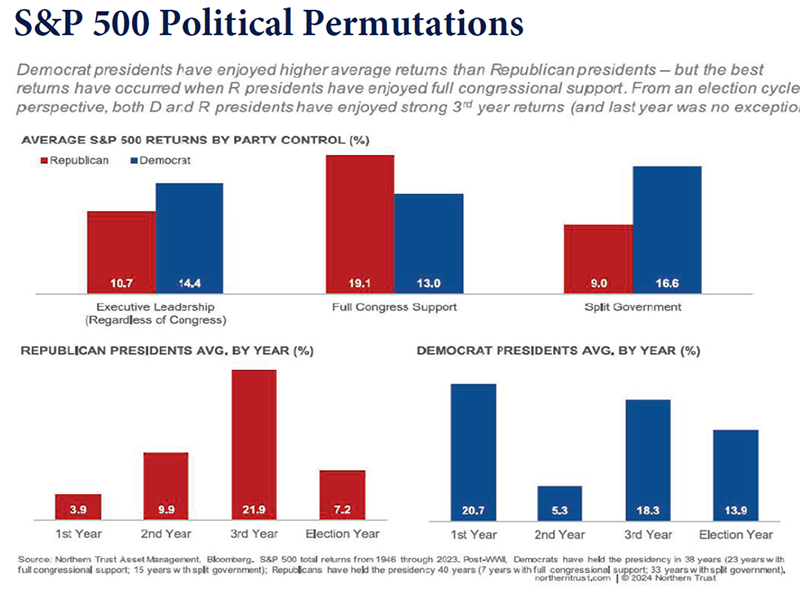
The US is clearly embroiled in one of the more contentious (and bizarre) election cycles in modern history. But from the perspective of investors and fiduciaries, we would argue that the current election season features a whole lot of noise and very little signal. Both candidates propose policies that seem economically dubious. One candidate proposes extreme progressive taxation schemes that seem a clear headwind for markets. The other proposes extreme regressive mercantilist tariff schemes that seem clearly inflationary. How much would either candidate actually seek to advance these policies, once in office? How feasible would it be for either candidate to implement them, especially given a potentially hostile Congress? And how much impact would those policies have on the long-term value of the companies and credits we buy for clients? We see a lot of noisy political pontificating, and very few signals with which to make informed investment decisions. What we know from history is that election years tend to be good ones for stocks overall, but they often feature a sell-off going into the election. Markets abhor uncertainty and so, typically, as the election uncertainty is withdrawn, stocks rally after the election into year-end. While we make no predictions about the election or the market's response to them, the historical pattern seems clear.
Moreover, if we look at historical patterns of party control of Congress and the White House, there are few clear patterns. In the long run, stocks tend to go up irrespective of who controls what seats in Washington. Both Democrats who predicted market collapse in 2016 (looking at you, Paul Krugman) and Republicans who went to cash in 2008 probably wish, with hindsight, that they had focused more on signal and less on noise.
Related to concerns over political risk is the current geopolitical backdrop. It’s not great. Between the war in Ukraine, a broadening war in the Middle East, and ongoing worries over China and Taiwan, I would be lying if I said the world today doesn’t appear to have the most geopolitical risk I’ve seen in my career. But what exactly are we do with that information? One logical move, which we’ve implemented for clients, is to own oil and gas stocks. (A broad global conflict, especially one emanating from the Middle East, would be likely to push oil prices higher, as we’ve already seen in recent weeks.) But again, as with the risks emanating from Washington, there are always geopolitical risks, and historically it’s always been a bad idea for long-term investors to focus too much on them. To invert the situation from one of geopolitical tension to seeming geopolitical nirvana, I think back to the beginning of my own career in finance, in 1999. There was relative peace in Middle East, the Cold War over, and the US had a budget surplus – a good time to invest, right? The next 10 years were one of the worst periods in modern history to be an investor.
Investment Takeaways
Last quarter, we warned of the potential for a “bad Goldilocks” environment for asset prices, in which bonds were priced for a recession (that was unlikely to materialize soon) and stocks were priced for strong growth (that was likely to disappoint). In the past quarter, we saw no sign of recession, yet bonds got even more expensive! Interest rates have fallen further, discounting a “hard landing” for the US economy. Stocks, despite recent volatility, remain priced for strong GDP gains and earnings growth.
While we can’t rule out the 2025 recession implied by the bond market, it is still not our base case. The rally in bonds since the Spring erodes the good value we identified at the time, and fixed income market now appear to be at the high end of a trading range, unless the labor market resumes the deterioration we began to see this Summer. With a sharp growth slowdown required for bonds to rally further, and huge Treasury issuance coming to market over the balance of the year, we are avoiding duration and structuring barbell portfolios of short-term Treasuries or corporates and longer-term municipals that can lock in strong all-in yields for income-focused investors while avoiding the duration risk of the benchmark.
Within equity markets, growth remains solid and the Fed is easing, but perhaps not as much as hoped. The realization that 200bps of cuts are not forthcoming might trigger a healthy (and buyable) correction heading into the election. Valuations are above historical averages and investor sentiment seems complacent. But the “melt-up” risk if the Fed delivers significant cuts despite a strong economy is real, so being underinvested in equities poses its own risks. As a result, we continue to be overweight quality stocks but are being increasingly selective in seeking out pockets of idiosyncratic value that are supported by secular growth themes. Some of these include infrastructure spend, energy and electrification, experiences over things, and secondary AI beneficiaries (beyond NVDA and other suppliers of picks and shovels to the AI platform shift we discussed in our last Outlook). These areas should fall less in a market correction and have longer runways to growth. Small caps and emerging market stocks remain relatively attractive despite recent outperformance and will benefit in a melt-up scenario.
While the US economy remains resilient, parts of Europe are close to recession. Japan is trying to strengthen their currency but has caused ripple effects globally by raising rates. China is trying to salvage their economy and seems to bring out a new stimulus policy daily. With so much macro uncertainty, we see diversifying liquid alternatives as a good tool to reduce portfolio risk and diversify.
We continue to spend our time trying to identify the signals and filter out the noise. Good luck in the fourth quarter. Please don’t hesitate to reach out to our team any time if you have questions.
We provide the information in this newsletter for general guidance only. It does not constitute the provision of legal advice, tax advice, accounting services, investment advice, or professional consulting of any kind. The information provided herein should not be used as a substitute for consultation with professional tax, accounting, investment, legal, or other competent advisers. Before making any decision or taking any action, you should consult a professional adviser who has been provided with all pertinent facts relevant to your particular situation. The information is provided “as is,” with no assurance or guarantee of completeness, accuracy, or timeliness of the information, and without warranty of any kind, expressed or implied, including but not limited to warranties of performance, merchantability, and fitness for a particular purpose.
Investment and Insurance Products are:
Not Bank Guaranteed | Not a Deposit | May Lose Value
Not FDIC Insured | Not Insured By Any Federal Government Agency