


Market Update
Thu, 09/04/2025 - 09:01 Wealth management

(502) 259-2543 | John.Fidler@syb.com
Macroeconomic forces move slowly, and they do not meaningfully change every quarter or even every year. This is one reason why, as discussed in recent Investment Outlooks, a diversified “stay the course” approach to investing makes a lot of sense. Owning market beta in the form of quality growth stocks (both domestic and international), complemented with high quality fixed income, and rebalancing periodically to take advantage of tactical opportunities is an approach to investing that has worked over the long term. But several major market forces are coalescing that argue for diversifying assets in a way that has not been the case for at least three years:
- Historically high tariff rates. These function like a tax increase. They are a drag on economic growth and at least a one-time bump to inflation.
- Increased coordination between the Fed and Treasury and threats to Central Bank independence. The Fed has ceded a major lever of monetary policy to the Treasury. This began under the prior Administration when the Treasury began financing the US deficit predominantly with short-term Treasury bills (instead of long-term bonds) and this continues today. The Fed appears biased towards easing even though financial conditions remain loose, and this trend is likely to accelerate with the appointment of a new Fed Chair in nine months.
- Proactive fiscal policy (see above) and the “One Big Beautiful Bill” lock in deficit spending for the foreseeable future. The Treasury (past, present, and future, regardless of political party) is politically incentivized to boost economic growth even at the expense of higher inflation.
- Shifting capital flows have and will continue to occur as a result of these developments. We need to look no further than the poor YTD performance of the US dollar and the strong YTD performance of international stocks relative to US stocks.
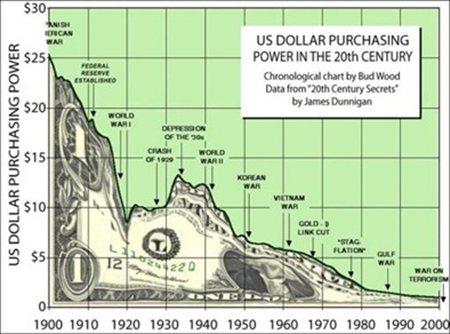
All four of these factors are inflationary and/or bearish for the US dollar over a multi-year time frame, as well as a continuation of the structural erosion of purchasing power that has occurred over the past century.
The potential dynamic of structural higher inflation is particularly acute for bond investors, as bonds are especially inflation-sensitive, as we just witnessed in 2022.
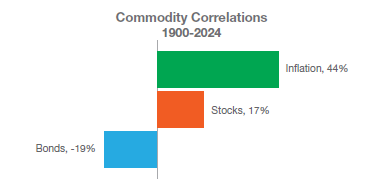
As a result, the case for assets that can protect portfolios against inflation and US dollar debasement, or stores of value, is stronger than it was 6-12 months ago. Such real assets have included real estate, Treasury Inflation Protected Securities (TIPS), gold and commodities, farmland, timber, infrastructure, etc.
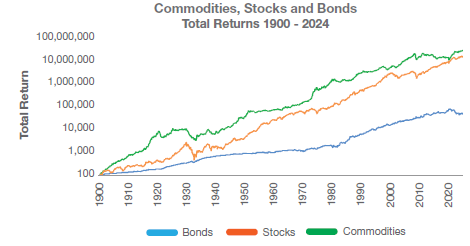
Constructing a portfolio of these assets that is liquid, easy to own, and provides true diversification requires careful thought. The less liquid of these investments (e.g. farmland) have demonstrable track records of absolute return and inflation protection but can present liquidity and access challenges. TIPS utilize a government-derived inflation benchmark and have a spotty track of providing protection to portfolios. Gold has performed well of late, (as well over the long-term) but is a single asset with its own idiosyncratic fundamentals and it also has a less than 1-to-1 correlation with inflationary episodes. While it warrants inclusion in a basket designed to protect purchasing power from fiat debasement, we prefer to utilize appropriately-sized, low-cost, highly liquid fund strategies with sensible portfolio construction rules that provide exposure to a broad-based basket of commodities. This approach has a proven track record of serving as a store of value and providing portfolio protection against an ongoing trend which we believe is likely to persist over the next five to ten years.
We provide the information in this newsletter for general guidance only. It does not constitute the provision of legal advice, tax advice, accounting services, investment advice, or professional consulting of any kind. The information provided herein should not be used as a substitute for consultation with professional tax, accounting, investment, legal, or other competent advisers. Before making any decision or taking any action, you should consult a professional adviser who has been provided with all pertinent facts relevant to your particular situation. The information is provided “as is,” with no assurance or guarantee of completeness, accuracy, or timeliness of the information, and without warranty of any kind, expressed or implied, including but not limited to warranties of performance, merchantability, and fitness for a particular purpose.
Investment and Insurance Products are:
Not Bank Guaranteed | Not a Deposit | May Lose Value
Not FDIC Insured | Not Insured By Any Federal Government Agency