


Q4 2025 Fixed Income Outlook
Fri, 10/24/2025 - 13:42 Wealth management

(502) 259-2505 | Mike.Arnold@syb.com
Attractive Income, but Tight Risk Premia Calls for Thoughtful Approach
Key Takeaways
- Fed likely to cut at least one more time by year-end as growth cools and political pressure mounts, fueled by jobs concerns.
- 10-year Treasury remains the key transmission mechanism for mortgages, loan rates, and consumer financing; yields are still elevated.
- Credit spreads historically tight, meaning investors are being paid less for credit risk even as all-in yields remain compelling.
- We favor high-quality issuers, careful name selection, and duration slightly short of the index to balance income opportunities with risk.
As we enter the final quarter of 2025, bond markets are characterized by a mix of moderating inflation, shifting Federal Reserve policy, and strong investor demand for income. After two years of aggressive tightening, the Fed is widely expected to cut rates twice more by year-end, with at least one cut likely in our view. Slower growth, easing inflation pressures, and clear political momentum toward lower borrowing costs — including President Trump’s focus on reducing mortgage rates and consumer financing costs — all support this view focused around the 10-year Treasury yield.
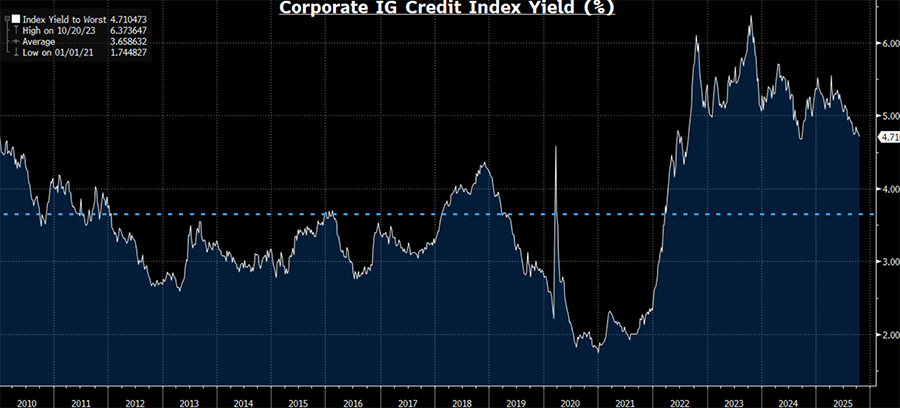
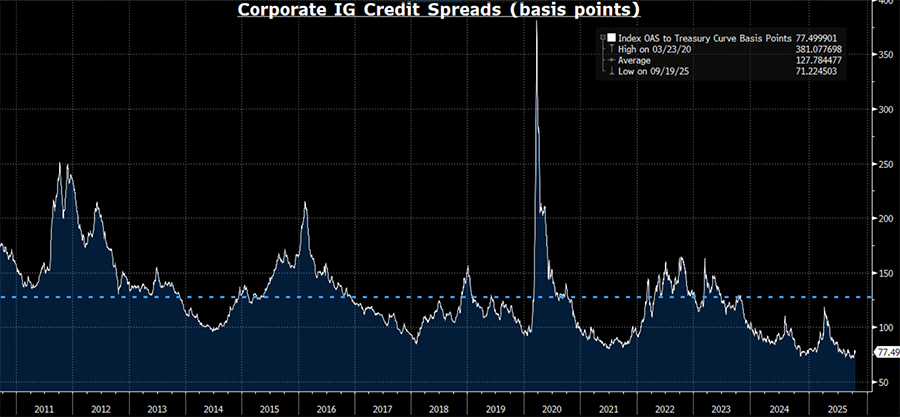
This evolving environment creates both opportunity and complexity for fixed income investors. All-in yields remain among the most attractive witnessed in over a decade, yet credit spreads (the extra compensation investors earn for taking on corporate default risks) are near historic lows.
All these factors call for a thoughtful, disciplined approach. Consumer spending has softened in the face of diminishing excess savings, while the labor markets rebalance, and corporate earnings growth has moderated. Inflation, while not fully back to the Fed’s 2% target, is clearly trending in the right direction. Core PCE — the Fed’s preferred gauge — has declined significantly from its 2022 peak with forward-looking expectations remaining well-anchored.
With policy still restrictive and real interest rates elevated, the Fed now has room to move closer to a neutral stance. Two additional 25-basis-point cuts this quarter would help bring borrowing costs down and support continued economic expansion. That easing, combined with political pressure to boost housing and consumer activity, suggests the front end of the yield curve is likely to drift lower into 2026. A concern is the President’s persistent rhetoric around bringing rates back down, which suggests further easing as membership of the Fed board is re-engineered in the coming months.
Importantly, the 10-year Treasury yield remains the critical reference point for mortgages, auto loans, and much of household/corporate borrowing. After peaking earlier in this tightening cycle, it has moderated but remains elevated by historical standards. Even in the 3.75%–4.25% range, the 10-year offers income opportunities that were elusive for much of the past decade.
Further Fed cuts may help push longer-term yields lower, though fiscal deficits, heavy Treasury issuance, and shifting growth expectations may limit how far they fall. Investors should expect some volatility, but the overall backdrop supports an environment where bonds once again provide meaningful income and portfolio diversification.
The most striking feature of credit markets today is the historic tightness of spreads. Investment-grade corporate bonds trade at spreads near levels last seen in the mid-2000s and even the 1990s, while high-yield spreads (risk premia) remain well inside their long-term averages. This reflects strong corporate fundamentals, low default rates, and persistent demand from yield-hungry investors along with cannibalization of new HY issuance via private credit. Admittedly, tight spreads mean investors are being paid less to take credit risk. If economic growth slows more than expected or corporate fundamentals weaken, current valuations leave little room for error. In our view, despite these issues, all-in yields remain attractive, nonetheless. Because Treasury yields are still relatively high, even high-quality issuers offer income levels that would have been unthinkable just a few years ago — often near or above 5% -- meaning investors can build portfolios with attractive income streams without taking on excessive credit or duration risk. This tension of tight risk premia but historically attractive nominal yields defines today’s unique opportunity set.
In Municipals, the market reflects a year defined by record-breaking issuance and resilient investor demand. Historic supply through the spring and summer weighed on valuations for much of the year. This said, it also created opportunities, particularly in the intermediate to long end of the curve, where yields remain compelling relative to both Treasuries and recent history. Municipals regained momentum in September, outperforming all major fixed income sectors and drawing renewed attention from investors seeking tax-advantaged income. Fundamentally, the market remains sound. State and local governments continue to demonstrate disciplined fiscal management, supported by strong tax revenues and healthy reserve balances. While select sectors such as higher education and smaller healthcare systems show modest strain, upgrades continue to outpace downgrades, and default activity remains exceptionally low underscoring the asset class’s durability amid a slower economic backdrop.
Looking ahead in Munis, seasonal dynamics will play a key role into year-end. October, traditionally one of the heaviest months in terms of new issuance, appears on track to follow that pattern in 2025. Elevated new supply may exert short-term pressure on valuations, but it also presents attractive entry points for investors to add exposure at wider Muni-to-Treasury ratios. As issuance typically slows in November and December, technicals are expected to strengthen as reinvestment demand exceeds supply. Combined with expectations for continued Federal Reserve easing, the backdrop into year-end remains constructive, favoring carry and roll-down strategies across the steep intermediate portion of the curve.
Given this backdrop, we believe fixed income should remain a core part of diversified portfolios— but with a focus:
- Focus on quality: With spreads compressed, we favor investment-grade issuers and strong balance sheets. This is not an environment to stretch aggressively for yield.
- Prioritize name selection: When valuations are rich, the difference between strong and weak issuers matters more. Careful credit research and security selection can add meaningful value. Capital structure plays in high quality issuers are attractive as well.
- Munis: Prefer carry and roll-down opportunities across the attractively steep intermediate curve.
- Keep duration slightly short: With the yield curve still adjusting and fiscal dynamics potentially pushing long-term rates higher, we prefer to stay a bit short of benchmark duration in taxable, while opportunistically extending duration in tax-frees. This provides flexibility to extend if yields rise or the Fed cuts more aggressively.
While our base case is constructive, several risks bear watching. A renewed pickup in inflation could slow or reverse the Fed’s easing path. Rising fiscal deficits and increased Treasury issuance could pressure long-term yields while the Treasury has ~$9 trillion in short term bills to roll or refinance. Moreover, unexpected geopolitical or financial shocks could quickly change the risk-reward balance in credit markets.
For fixed income investors, 4Q25 continues to offer income opportunities not seen in years despite the compressed spread environment. Policy easing, moderating inflation, and historically elevated yields combine to create a supportive backdrop. The fact that credit spreads are at multi-decade tights necessitate discipline. We see the best opportunities in higher-quality bonds, careful issuer selection, and portfolios positioned with modest duration.
We provide the information in this newsletter for general guidance only. It does not constitute the provision of legal advice, tax advice, accounting services, investment advice, or professional consulting of any kind. The information provided herein should not be used as a substitute for consultation with professional tax, accounting, investment, legal, or other competent advisers. Before making any decision or taking any action, you should consult a professional adviser who has been provided with all pertinent facts relevant to your particular situation. The information is provided “as is,” with no assurance or guarantee of completeness, accuracy, or timeliness of the information, and without warranty of any kind, expressed or implied, including but not limited to warranties of performance, merchantability, and fitness for a particular purpose.
Investment and Insurance Products are:
Not Bank Guaranteed | Not a Deposit | May Lose Value
Not FDIC Insured | Not Insured By Any Federal Government Agency