


Market Update
Mon, 03/03/2025 - 12:35 Wealth management

John M. Fidler | Chief Investment Officer
(502) 259-2543 | John.Fidler@syb.com
In our 2025 Market Outlook, we included a graphic from the album cover of the classic 1970 Crosby, Stills, Nash & Young record “Déjà Vu.” The idea was that the current market backdrop is reminiscent of the 2018-2019 period in more ways than one. The obvious is that we are entering four years of Trump 2.0, with a repeat of associated headline and macroeconomic risks (tariffs and trade wars being the biggest). The less obvious is that was a period when the Fed had been hiking rates, then paused, then ultimately began easing, with policy uncertainty and fears over “too tight” rates policy causing market jitters. What would have happened with economic policy in 2020 and beyond, had COVID not disrupted society, is something we’ll never know.
Since COVID, however, and especially since the Silicon Valley Bank (SIVB) panic in early 2023, macro narratives have oscillated from one extreme to the next seemingly every quarter. At the time of SIVB, bond markets expected the Fed to cut rates beginning that September. While the Fed did shield taxpayers from losses by injecting liquidity and backstopping depositors, they of course didn’t ultimately lower interest rates until September of 2024 as the economy remained on solid footing. At the start of 2024, markets expected 6-7 rate cuts, but yet again a resilient economy (and sticky inflation) threw cold water on those expectations. Similarly, we noted in our last Outlook “while animal spirits and optimism are high presently, a turning of the tide in business sentiment could underwrite a larger correction in 1H25.”
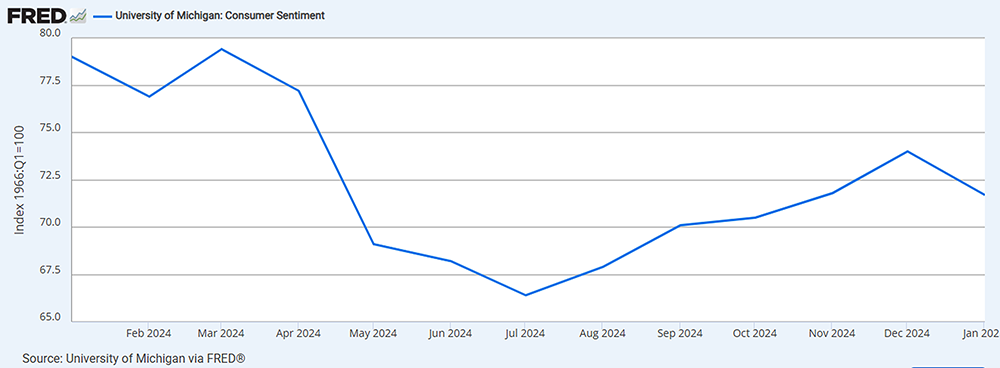
Last month seems to have marked just such a local peak in policy-related market euphoria, and a pendulum swing in the opposite direction. While equity markets sit just 3% off all-time highs, we are seeing a bit of a growth scare at present. Within the last 10 days: Retail sales data was very poor last Friday, Wal-Mart reported solid earnings but guided to a weaker 2025 (suggesting concern around consumer weakness), the services ISM survey came in weak, and consumer sentiment was also soft. These weakening data points have led to a decline in long-term interest rates.
Additionally, new Treasury Secretary Scott Bessent has publicly stated his desire to see the 10-year Treasury rate lower no less than three times in his first month on the job. Bessent has also stated that Biden era deficit spend had masked an economy that is “brittle” under the surface. While we don’t make political statements, our view is that Bessent is probably the most qualified Treasury Secretary since Bob Rubin during the Clinton Administration, and the person in the current Administration most worth listening to when it comes to reading the economic policy tea leaves.
As we’ve discussed with clients, 2025 is likely to be a year that “makes volatility great again.” Pro-business policies will (likely) ultimately lead to good economic and market outcomes, but policy volatility (like we are seeing at present, begets market volatility (like we are also starting to see).
Long-time clients and readers will know we anchor back to four key economic drivers when judging the health of the economy, and the likely forward path of growth, inflation, and Fed policy: (1) fiscal policy, (2) private sector wealth, (3) the availability and cost of credit, and (4) the labor market. As of year-end:
- Government deficit spending was a continued tailwind for markets (though a ballooning debt load is, we believe, unsustainable in the long term),
- Stock market and home price gains, combined with robust corporate balance sheets meant private sector wealth was healthy,
- Credit markets not restrictive with the fundamentals remaining healthy, and
- The labor market, while nowhere near as abnormally tight as during the post-COVID period in 2021-22, was far from recession levels.
All of these statements remain generally true, but three factors are combining to drive greater market uncertainty and an incrementally less pro-growth outlook.
First, as we’ve talked about for more than a year, inflation remains sticky. Core PCE, long the Fed’s preferred inflation metric, was 2.6% for the 12 months through January, and was 0.28% (3.4% annualized run-rate) month-on-month. Additionally, December Core PCE was revised up to 2.9%. This is down from peak levels of nearly 6% in 2022 but, zooming out, core inflation has basically flat-lined just below 3% for the past year, well above the Fed’s 2% target. This takes rate cuts off the table for the next few months. Continued lack of progress on inflation will make even the 2-3 rate cuts currently expected in 2025 tough to pull off, barring a real growth slowdown. (Expectation was for just 1-2 rate cuts a month ago, underscoring how quickly these expectations oscillate.)
Second, let’s think back to the “déjà vu” theme. In the Trump 1.0, tax cuts and other pro-growth policies came before embarking on more controversial and risky policies like tariffs. In Trump 2.0, the Administration is leading with spending cuts and tariffs, with deregulation and extensions of existing tax cuts TBD. The DOGE initiative, whatever one thinks of its merit or manner of execution, if “successful,” means less spending. Incremental austerity (again, whether one views that as great or terrible) is not a pro-growth policy. Tariffs are a form of tax, and a potentially inflationary one. Yes, those can be balanced with tax cuts, but as of now whether taxes are actually lowered or the existing tax level is simply extended remains an open question. The economic policies proposed by President Trump on the campaign trail were (in our view) pro-domestic growth in aggregate, the policies that the Administration is leading with are not a pro-growth mix.
Third, while our investment framework focuses on company fundamentals, valuations, and the macroeconomic backdrop, it is useful to look at seasonal and technical patterns to put market movements in context. The average first year of the Presidential cycle has resulted in about 6% returns since 1929 (in line with our rough estimate of mid-single digit returns for US equities in 2025). But there is pronounced seasonality to those returns, probably not coincidental given the policy uncertainty that often surrounds a new President. February has historically been the worst month of those years, with an average return of -1.7%. However, seasonality suggests that this post-February rally can be pronounced. This jibes with our view that we might see a good buying opportunity for equities in late Q1.
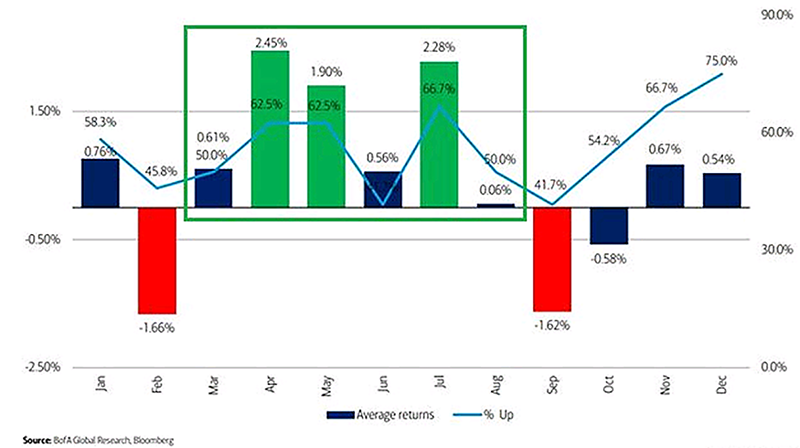
From a purely technical perspective, there appears to be decent support for the S&P 500 in the 5700-5800 area, but a move below 5700 and/or persistent market weakness into 2Q, might signal a more concerning break with this seasonal trend. Single-stock volatility remains high (as it did last year when index level volatility was low) and while we continue to identify pockets of value for clients within equity markets, we would likely get more aggressive at those price levels as more value opportunities emerge.
We provide the information in this newsletter for general guidance only. It does not constitute the provision of legal advice, tax advice, accounting services, investment advice, or professional consulting of any kind. The information provided herein should not be used as a substitute for consultation with professional tax, accounting, investment, legal, or other competent advisers. Before making any decision or taking any action, you should consult a professional adviser who has been provided with all pertinent facts relevant to your particular situation. The information is provided “as is,” with no assurance or guarantee of completeness, accuracy, or timeliness of the information, and without warranty of any kind, expressed or implied, including but not limited to warranties of performance, merchantability, and fitness for a particular purpose.
Investment and Insurance Products are:
Not Bank Guaranteed | Not a Deposit | May Lose Value
Not FDIC Insured | Not Insured By Any Federal Government Agency